
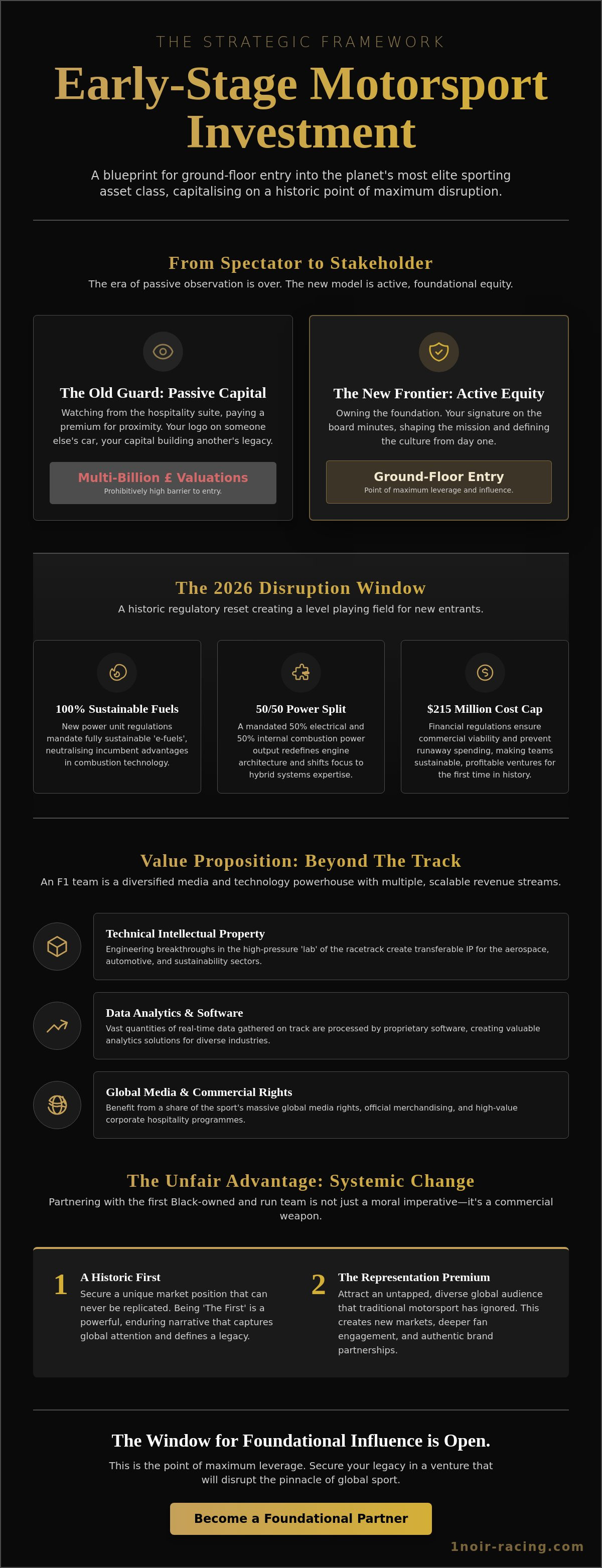
The paradigm of high-stakes sporting investment is shifting. The traditional model of passive sponsorship is obsolete, replaced by a demand for foundational equity and direct influence. Early stage motorsport investment is no longer about underwriting a passion project; it is about acquiring a strategic position within a global media and technology powerhouse at the point of maximum disruption. The world of Formula 1, once a closed circle, is facing a regulatory reset that creates a historic, finite window for new entrants.
This is the strategic framework for ground-floor entry into the world’s most elite sporting asset class. It is a guide for the high-net-worth individuals, venture capitalists, and corporate strategists who understand that true legacy is not bought, but built. The 2026 season does not just represent a new set of rules; it represents a historic investment window, an opportunity to architect a team from its very foundation and, in doing so, redefine the future of the grid.
What is Early Stage Motorsport Investment?
Early stage motorsport investment is the deployment of capital during the foundational phase of a new racing team—before an entry is formally granted, before a car has turned a wheel, and before valuations reach the stratosphere. It is the antithesis of acquiring a stake in an established incumbent, where multi-billion-pound price tags reflect decades of baked-in brand value and infrastructure. This is about ground-floor entry, where influence is absolute and the potential for value appreciation is at its peak.
The current Formula 1 climate, driven by a global surge in viewership and the implementation of a cost cap, has transformed teams from cash-burning marketing exercises into profitable, sustainable franchises. This shift has made new team entries the most sought-after assets in the sporting world. Consequently, modern investors are no longer content with passive sponsorship; they demand active equity participation, recognising that the real value lies in ownership, not association.
The Evolution of the Racing Asset Class
The journey of a Formula 1 team as an asset has been one of radical professionalisation. The era of ‘gentleman drivers’ funded by personal wealth has given way to a landscape dominated by institutional venture capital, private equity, and sovereign wealth funds. Why? Because the perception of a team has fundamentally changed. They are no longer just racing outfits; they are cutting-edge technology hubs, global media franchises, and powerful platforms for brand building.
The introduction of the budget cap has been the single most important catalyst in this evolution. By limiting expenditure, the sport’s governing body has engineered a system where fiscal responsibility is not just encouraged but required. For the first time in its history, Formula 1 offers a clear and predictable path to profitability, making team ownership a viable and highly attractive long-term investment rather than a notorious money pit.
Why Timing is the Ultimate Differentiator
In the world of high-stakes investment, the debate between ‘entry fee’ and ‘value appreciation’ is critical. Waiting for a team to prove its concept on the track is a costly mistake, a forfeit of the exponential growth that occurs in the pre-launch and initial growth phases. Early-stage backers, by contrast, enter when the perceived risk is highest, and in doing so, they secure the most preferential terms, the greatest equity dilution protection, and the most significant influence over the team’s foundational DNA.
These foundational partners are not merely providing capital; they are shaping the organisation’s culture, its technical direction, and its commercial strategy from day one. They sit at the table where the core decisions are made, long before the C-suite is fully formed or the strategic path is set in stone. In short, early-stage entry is the point where risk is highest but influence is absolute.
Decoding the Value Proposition: Beyond the Track
To truly understand the value of an F1 team, one must look beyond the two hours of a Grand Prix on a Sunday. The modern team is a diversified business with a sophisticated portfolio of revenue streams. These include a share of the sport’s burgeoning media rights, high-end corporate hospitality, lucrative technical partnerships with global brands, and an ever-expanding merchandising operation. The scarcity principle underpins all of this: with a maximum of 12 teams permitted on the grid, ownership slots are among the rarest and most prestigious assets in global sport.
Beyond these conventional streams lies the immense value of Intellectual Property (IP). An F1 team is a high-speed research and development laboratory, generating breakthroughs in materials science, aerodynamics, energy recovery systems, and data analytics. Furthermore, a team’s identity and mission can unlock unique value. The ‘Representation Premium’—the commercial power of a team built on a foundation of diversity and inclusion—attracts a global, untapped audience and aligns perfectly with the ESG (Environmental, Social, and Governance) mandates of modern corporations.
Intellectual Property and Technical Excellence
The engineering brilliance forged in the heat of motorsport competition has profound applications in the wider world. F1 technology consistently finds its way into the aerospace, automotive, and sustainability sectors. Advanced simulation models, lightweight composite materials, and hyper-efficient energy systems developed for the track are high-value assets that can be licensed or spun out into new commercial ventures. The team’s headquarters is not just a factory; it is ‘The Lab’, a place where proprietary technology is stress-tested under the most extreme conditions imaginable.
An investment in a new F1 team is therefore a stake in the future of mobility. It is an opportunity to be at the forefront of the transition to sustainable fuels, next-generation battery technology, and advanced manufacturing processes, securing a share of the IP that will define these industries for decades to come.
The Social Capital of Systemic Change
In today’s market, a powerful story is a powerful commercial asset. The mission to launch the first Black-owned and Black-run Formula 1 team creates a market position that is entirely unique and cannot be replicated by any incumbent. Being ‘The First’ generates immense social capital, attracting partners who want to be part of a new era for global motorsport. This is not about sentiment; it is about shrewd business.
The return on investment of diversity is tangible. It unlocks access to new demographics, energises fanbases, and meets the growing demand from corporate partners for authentic ESG alignment. The 1 NOIR Racing mission transcends sport. It is a platform for systemic change, a vehicle for representation, and a story that will resonate globally. For a foundational partner, this narrative is a powerful commercial multiplier, amplifying brand value and market reach far beyond the racetrack.
The 2026 Regulatory Shift: A Strategic Entry Window
The single greatest barrier to entry in Formula 1 has always been the monumental advantage held by established teams. Decades of accumulated data, entrenched infrastructure, and refined processes have created a performance gap that is almost impossible to close. The 2026 regulation overhaul is designed to shatter that paradigm. A complete redesign of the power unit and aerodynamic regulations effectively presses the ‘Reset Button’ on the entire competitive field.
The FIA, the sport’s governing body, has signalled its interest in expanding the grid, laying out a roadmap for new team applications. This confluence of regulatory change and a willingness to grow makes the period leading up to 2026 a once-in-a-generation opportunity. Established teams will see their historical data advantage nullified, whilst a new entrant can build its entire organisation—its people, processes, and technology—around the new ruleset from a clean sheet of paper. The key is to build the infrastructure *whilst* the final regulations are being finalised, creating a state of maximum readiness for the new era.
Levelling the Competitive Landscape
The 2026 regulations represent a seismic shift towards sustainability and efficiency. The move to 100% sustainable fuels and a near 50/50 split between internal combustion and electrical power provides a fresh start for all competitors. Engine manufacturers and teams must go back to the drawing board, creating an opportunity for innovation to triumph over incumbency.
A new entrant has the strategic advantage of being purpose-built for this new world. It carries no ‘legacy baggage’ from old designs or outdated infrastructure. It can recruit talent and implement processes specifically tailored to the 2026 ruleset. This agility and singular focus allow a new contender to be more efficient, more innovative, and ultimately, more competitive from the outset.
The Application and Entry Process
Gaining entry to the Formula 1 World Championship is a formidable challenge. The FIA has established a rigorous set of criteria that any prospective team must meet, covering technical capability, financial stability, and ethical standards. Applicants must demonstrate not only that they have the resources to compete but also that their presence will add value to the sport as a whole.
This is where the role of foundational partners becomes paramount. Their commitment is the ultimate proof of ‘Long-Term Viability’ to the sport’s governors. They are not just investors; they are co-validators of the project, signalling to the FIA and the F1 organisation that the team is built on a solid and sustainable foundation. In essence, the 2026 regulations are the single greatest entry opportunity in a generation, and early-stage capital is the key that unlocks it.
Managing Risk and Reward in Elite Motorsport Ventures
The primary objection to any motorsport investment is the perceived high cost of failure. Historically, the sport is littered with the ghosts of ambitious projects that ran out of money. However, the modern Formula 1 has been fundamentally restructured to mitigate this risk. The move towards a closed-league ‘franchise model’, akin to the NFL or NBA, is designed to protect the value of each entry on the grid.
For investors, due diligence remains critical. The quality of the founding team’s leadership and the depth of its engineering core are the leading indicators of future success. An investor must scrutinise the business plan, the technical roadmap, and the commercial strategy. Furthermore, clear exit strategies now exist. The secondary market for F1 team stakes is increasingly active, with a growing trend of minority share sales to institutional investors, providing liquidity options that were once unthinkable.
The Safety Net of the Franchise Model
Two key mechanisms protect the value of an investment in an F1 team today: the anti-dilution fee and the budget cap. The anti-dilution fee, a substantial payment shared amongst existing teams upon the entry of a new one, ensures that the overall value of the grid is not diminished. It acts as a powerful financial backstop, confirming that any new entrant is a serious, well-funded organisation.
The budget cap directly tackles the primary historical risk: uncontrolled spending. By placing a hard ceiling on performance-related expenditure, it prevents a financial arms race and forces teams to operate with ruthless efficiency. This has driven a paradigm shift from ‘spending to win’ to ‘operating for profit’. As a result, F1 teams are now increasingly resilient to broader economic downturns, functioning as stable, high-growth assets.
Evaluating Leadership and Vision
In a landscape being reset, the right leadership is everything. A new team cannot succeed by copying the incumbents; it must possess ‘Disruptor DNA’. A vision like that of 1 NOIR Racing—to build the first Black-owned and Black-run team—is not just a social mission; it is a strategic advantage. It signals an innate understanding of modern markets, brand building, and the cultural currents that shape the new global economy.
For stakeholders, transparency and directness are non-negotiable. The 1 NOIR Racing approach is built on this principle, favouring candid communication and a clear-eyed balance between the passion of the track and the cold logic of the boardroom. The leadership team must demonstrate not only a love for the sport but a mastery of the complex financial and political environment in which it operates.
1 NOIR Racing: The Architect of Systematic Change
1 NOIR Racing is the definitive vehicle for strategic early stage motorsport investment ahead of the 2026 reset. It is the materialisation of a mission to field the first Black-owned and Black-run team in the history of Formula 1. This is not an application to join the grid; it is a plan to redefine it.
We are not soliciting sponsors. We are inviting high-level collaboration from industry experts, sports personalities, corporate visionaries, and strategic capital partners who share our ambition. This is a call to those who understand that the greatest returns—both financial and societal—come from being part of a foundational shift. The immediate next steps are for those ready to move from observation to active participation in this historic venture.
A Manifesto for the Future
We are not just building a car. We are building a platform for global representation, a pipeline for diverse talent, and a new benchmark for excellence. Our purpose is to prove that diversity is not a compromise on performance but the very engine of it. For our founding partners, this presents a unique opportunity to shape the team’s DNA from day one, embedding their own values and vision into the fabric of a future F1 contender.
This is an invitation to join a journey where victory is measured in championships and in the systemic change we create. A journey where excellence is the only standard and diversity is the competitive edge.
Securing Your Seat at the Table
The window of opportunity is now. We are engaging in confidential dialogues with strategic partners and capital investors who have the vision and capacity to help architect this historic entry into Formula 1. If you are ready to move beyond the hypothetical and participate in the creation of history, the time to act is now.
To initiate a discussion with the 1 NOIR Racing leadership and explore a foundational partnership, we invite you to make direct contact. Participate in the creation of history with 1 NOIR Racing.
Frequently Asked Questions
Is it still possible to invest in a new F1 team given the high entry barriers?
Yes, but the window is specific and strategic. The 2026 regulation overhaul creates the most significant opportunity in over a decade for new, well-funded, and technically credible teams to enter the sport. Early-stage investment is critical to navigating the FIA's application process and building the necessary infrastructure ahead of time.
What is the minimum level of involvement for an early stage motorsport investor?
Early-stage involvement is typically reserved for strategic partners and significant capital investors (HNWIs, VCs, Private Equity) whose contribution is foundational to the team's viability. It is less about a minimum cheque size and more about a strategic alignment and a long-term commitment to the project's vision.
How does the 2026 regulation change affect the value of new team entries?
The 2026 changes significantly increase the potential value of a new team. By resetting the competitive order and nullifying the historical data advantages of incumbent teams, the regulations give a well-prepared new entrant a genuine opportunity to be competitive from the start, thereby accelerating its potential valuation growth.
Why is the first Black-owned F1 team considered a high-growth investment?
This historic first creates a unique and powerful market position. It unlocks access to new global audiences, attracts corporate partners seeking authentic ESG alignment, and generates a level of media interest that a conventional entry could not. This "Representation Premium" acts as a commercial multiplier, driving brand value and revenue potential.
What is the difference between a team sponsorship and a foundational partnership?
Sponsorship is a marketing expense for brand exposure. A foundational partnership is an equity investment in the team itself. Partners are owners; they have a voice in the team's strategic direction, share in its financial success, and help build its long-term legacy.
How does the F1 budget cap protect early stage investors from overspending?
The budget cap places a hard limit on performance-related expenditure, preventing the uncontrolled spending wars that previously made F1 unsustainable. This financial regulation forces teams to operate as efficient businesses, protecting investors' capital and creating a clear pathway to profitability.
What happens if a new team application is not immediately successful?
The capital raised and infrastructure built during a serious application process are valuable assets. The organisation can pivot, refine its approach for the next opportunity, or explore other top-tier motorsport categories. Foundational partners are involved in shaping this long-term strategy, ensuring the venture's value is preserved regardless of the initial outcome.
Can corporate partners take an active role in the team's leadership or engineering?
Yes. A key benefit of being a foundational partner is the opportunity for direct involvement. This can range from a seat on the board to the integration of a partner's technology and personnel through technical collaborations, creating a deeply embedded and synergistic relationship.