
Why pay $110 million annually just to watch your logo blur past at 200 miles per hour? In an era where total sponsorship spend is projected to exceed $3 billion, the traditional Formula 1 sponsorship deal has become a race toward invisibility. You feel the diminishing returns. You see the oversaturated sidepods. The market is loud; the message is often hollow. It is time to stop buying space. It is time to start building legacy.
The 2026 season represents a seismic shift. With the introduction of 100% sustainable fuels and a $565 million surge in tech sector investment, the landscape is transforming. This guide provides the framework to master elite partnerships whilst avoiding the high entry barriers that stifle traditional ROI. We will explore how to move beyond passive branding. You will discover how to align with historic movements that offer direct involvement in team leadership. The 2026 grid isn't just about faster cars. It is about who has the courage to lead the next era of prestige. It is about whether you want to observe history or own it.
Key Takeaways
- Recognise why passive branding is failing and how the 2026 regulations demand a shift toward strategic, multi-layered alliances.
- Identify the specific tiers of partnership to ensure your Formula 1 sponsorship deal secures the level of naming rights and technical integration your brand requires.
- Evaluate the "Legacy Multiplier" to understand why being a historic first provides greater long-term equity than simply being the highest bidder.
- Apply a precise due diligence checklist to audit team leadership and technical roadmaps before entering the high-stakes motorsport environment.
- Discover the singular opportunity to align with the first Black-owned and run team as a transformative entry point for global brand leadership.
The Evolution of the Formula 1 Sponsorship Deal in 2026
The "sticker on a car" is a relic. It belongs to a museum of missed opportunities. Today, a Formula 1 sponsorship deal is a high-stakes, multi-layered commercial alliance. It's a strategic ecosystem partnership. The landscape has shifted because the audience has shifted. With a 68% increase in sponsorship from US-based companies since 2023, the valuation of the grid has exploded. Viewership in Asia and North America has turned F1 from a European hobby into a global commercial juggernaut. To understand how we arrived here, one must look at The Evolution of F1 Sponsorship, which tracks the move from simple aesthetics to integrated technical identities.
The 2026 Regulatory Landscape
The 2026 regulations aren't a mere update. They're a fundamental reset of the sport's DNA. The new power units demand a 50/50 split between internal combustion and electric power. This technical complexity creates a vacuum that only sophisticated tech partners can fill. Technology sector investment has already surpassed $565 million in 2026. The cars are now mobile R&D labs for the future of transport. The cost cap has also changed the game. Every pound of sponsorship revenue is now a direct contributor to on-track performance. If you aren't providing technical value or significant capital, you're just noise. Key technical shifts include:
- Power Unit Split: A 50/50 balance between electric and internal combustion engines.
- Sustainable Fuel: A mandatory shift to 100% advanced, carbon-neutral fuels.
- Active Aerodynamics: Movable front and rear wings to reduce drag by 55%.
Sustainability is no longer a choice. With the mandate for carbon-neutral fuels, brands must align with F1’s Net Zero 2030 goals or risk total irrelevance amongst a climate-conscious fan base.
The Shift Toward Representation
The most significant change in 2026 isn't mechanical. It's social. There's a rising, undeniable demand for diversity in motorsport leadership. This isn't about optics. It's about commercial value. Investors now recognise that traditional, homogenous team structures limit market reach. 2026 is the year of the socially conscious Formula 1 sponsorship deal. Brands are moving away from performative inclusion. They want structural partnership. They want to be part of a historic first. The industry is finally admitting a hard truth: representation is a competitive advantage. If your partnership doesn't reflect the global diversity of your customers, it's a failed investment. Structural change is the only currency that matters on the 2026 grid.
Decoding the Tiers: From Technical Partner to Title Sponsor
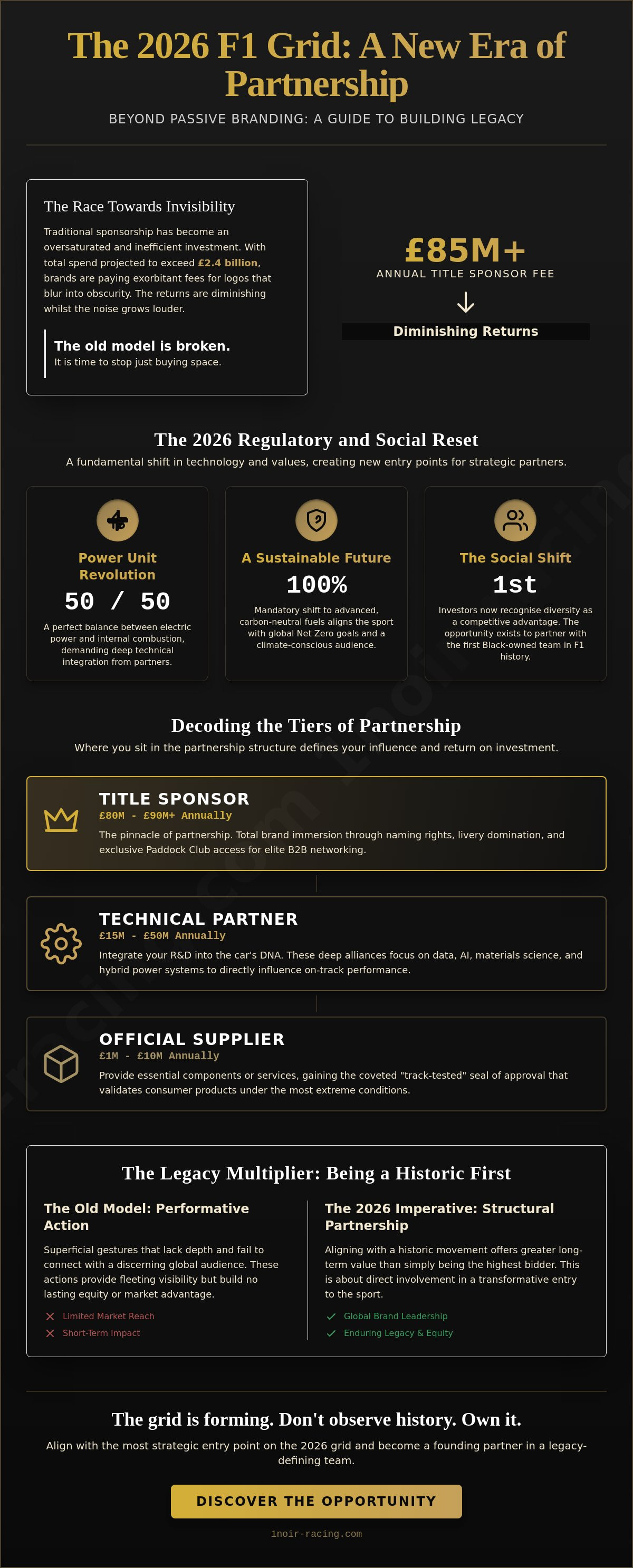
The hierarchy is absolute. In this sport, where you sit in the partnership structure defines your influence. A Formula 1 sponsorship deal is not a flat purchase; it is a ladder of increasing immersion. At the base, you find the suppliers. At the summit, you find the title sponsors who dictate the very identity of the team. Understanding these tiers is essential for evaluating ROI and team value before committing capital. Each level offers a different degree of access, visibility, and technical integration.
Title Sponsorship is the pinnacle. It is total brand immersion. Look at Oracle’s $110 million annual commitment to Red Bull or HP’s $100 million deal with Ferrari. These aren't just logos; they are naming rights. They dominate the broadcast narrative. Every time a commentator speaks the team name, they speak the brand. Technical Partnerships are deeper. They involve integrating your R&D into the car’s DNA. With tech sector investment reaching $565 million in 2026, these deals focus on data, AI, and materials science. You don't just watch the race; you power the win. Official Suppliers sit below this, providing the "track-tested" seal of approval that validates consumer products under extreme stress.
The Title Sponsor Advantage
Naming rights provide the ultimate "Seconds on Screen" (SOS) metrics. It is the difference between a glimpse and a constant presence. You own the digital mentions. You own the primary livery real estate. Beyond the screen, the Paddock Club offers exclusive hospitality. It is the world's most elite B2B networking environment. It is where deals are signed whilst the engines roar in the background. If you seek this level of strategic motorsport alignment, you must be prepared for a multi-year commitment that transcends simple advertising.
Regional and Lifestyle Partners
Not every brand needs a global title. Regional deals allow you to dominate specific markets. US-based sponsorship has grown by 68% since 2023. You can own the North American narrative without the $100 million price tag. Lifestyle and fashion partners, like Puma and Adidas with their $140 million 2026 deals, merge racing culture with high-end consumerism. This captures the Gen Z audience through virtual platforms and esports. The grid is diversifying. The entry points are multiplying. You must choose the tier that matches your ambition, or you risk being lost in the noise of the mid-field.
Beyond the Livery: Evaluating ROI and Social Equity
Traditional metrics are dying. Why measure impressions when you can measure impact? A Formula 1 sponsorship deal in 2026 must account for the Legacy Multiplier. This is the premium placed on being a pioneer. Most teams offer a billboard; a few offer a history book. The sticker is a commodity. The movement is a manifesto. In an oversaturated market, brand recall is no longer tied to the size of a logo. It's tied to the gravity of the story. If your brand isn't part of a historic shift, it's merely background noise.
Association with the first Black-owned Formula 1 team isn't a charity. It's a commercial masterstroke. It taps into a global demographic that has been ignored by this sport for 75 years. It creates brand affinity that transcends the track. When you align with representation, you aren't just buying space. You're buying a connection to a community that values structural change over performative gestures. This is how you solve the problem of diminishing brand recall in a crowded marketplace.
ESG reporting has moved from the footer of an annual report to the centre of the boardroom. Sponsors now demand proof of social equity. They want to see representation in the engineering bay. They want to see diversity in the pit lane. This isn't optional. It's a core component of the modern deal. Measuring impact now requires looking at how representation in leadership drives consumer loyalty and brand prestige. If the team doesn't reflect the world your customers live in, the partnership is a liability.
The ROI of Systemic Change
Quantifying the PR value of disruption is simple. Compare the cost of a standard mid-field logo to the global headlines generated by a historic first. The difference is the disruption dividend. It also serves as a beacon for talent. Top-tier engineering minds no longer just want to build fast cars. They want to build a better industry. Purpose-driven sports investments are surging because they offer a higher emotional ROI for both employees and consumers. You aren't just sponsoring a race; you're sponsoring a revolution.
Intangible Assets: Access and Influence
Access is the ultimate currency. Joining the Founder’s Circle of a team provides a seat at the table during the most critical phase: inception. It offers direct access to global decision-makers and F1 leadership. You aren't just a guest in the Paddock Club. You are an architect. Being part of this pioneering motorsport venture gives your brand the authority of a leader. It positions you amongst the visionaries who didn't just watch the grid change. You forced the change. This is the prestige that money alone cannot buy.
The Due Diligence Checklist: Securing an Elite Partnership
Excellence is never an accident. It is the result of rigorous, uncompromising scrutiny. Before you sign a Formula 1 sponsorship deal, you must strip away the marketing gloss. You need to see the machine underneath. A multi-million pound commitment requires more than a handshake; it requires a forensic audit of the team’s viability and vision. In a sport where 0.001 seconds matter, your due diligence must be equally precise. If the foundations are weak, no amount of branding will save the investment.
Audit the roadmap with clinical detachment. Is there a clear, documented path to the 2026 grid? With new entrants like Audi and Cadillac shifting the competitive balance, a team without a robust technical strategy is a liability. You must evaluate the leadership. Does the management have a history of excellence in high-pressure environments? Precision in the pit lane starts in the boardroom. Finally, assess the intellectual property. If you aren't gaining access to technical innovations or R&D insights, you are merely a bank, not a partner. Verify the values. Does the team’s mission survive a "performative vs structural" test? If representation is just a PR tactic, it will fail the first time it faces a crisis.
Commercial Terms and Flexibility
Rigidity is the enemy of ROI. You must negotiate exit clauses that protect your brand and performance-based escalators that reward success. Stagnation is not an option. Ensure total exclusivity within your industry category. You cannot afford to share the spotlight with a direct rival. Beyond the car, you must secure long-term rights to digital assets and "Behind the Scenes" content. In the modern era, the narrative is as valuable as the race result. You are buying the right to tell a story. Make sure you own the script.
Technical and Operational Integration
For technical partners, the deal lives or dies on data sharing. You need a transparent agreement that allows your engineers to collaborate with the team’s technical staff. Your products should be integrated into the team’s operations, providing a "track-tested" validation that no laboratory can replicate. Consider the balance of on-car placement versus digital overlay rights. As broadcasts become more interactive, your presence must exist in both the physical and virtual worlds. If you are ready to move beyond the checklist and lead a historic movement, explore the opportunity to get involved in the first Black-owned and run F1 team.
1 NOIR Racing: The Most Strategic Entry Point on the Grid
The grid is crowded. The noise is deafening. Yet, amongst the roar of existing giants, a singular gap remains. 1 NOIR Racing is not just another entry; it is a historic first. It is the first Black-owned and run team in the history of the sport. This is an unrepeatable entry point. You cannot buy history once it has already been written. You must be the one to write it. For a brand seeking the ultimate Formula 1 sponsorship deal, the choice is clear: do you want to be the hundredth sponsor on a legacy car, or the founding partner of a new era?
Why does this matter now? Because 1 NOIR Racing represents the most significant Formula 1 partnership opportunity in a decade. It is a manifesto for systemic change. Most teams offer you a seat in the grandstand. We offer you a seat at the foundation. This is where your brand stops being a spectator and starts being an architect of the future. The 2026 regulatory reset is the perfect moment for high-performance disruption. It is the moment where the status quo is vulnerable. We are here to exploit that vulnerability.
Prestige with a Purpose
We combine the elite aura of Formula 1 with a human-centric mission. We are stripping away the fluff. There are no performative gestures here. We are building a competitive entry designed for the 2026 technical landscape. Our vision is direct. It is uncompromising. We understand the technical and financial landscape, but we speak with the passion of social pioneers. We don't just want to participate; we want to lead. This is prestige with a purpose. It is a brand alignment that offers more than visibility. It offers historic equity.
Join the Movement
Collaboration is the only path to greatness. Anthony Danquah is inviting high-level, visionary leaders to join this journey at the ground level. This is about more than capital. It is about securing equity and direct involvement in the foundation of the team. Don't wait for the first lights to go out. By then, the legacy will be claimed. The opportunity to be a "first" only happens once. Enquire about partnership opportunities today to start your journey. The grid is waiting. The future is ours to build. Will you lead, or will you follow?
Own the Grid: The Future of Motorsport Equity
The 2026 grid is not a destination. It is a departure point. We have moved beyond the era of passive visibility. A modern Formula 1 sponsorship deal must be a declaration of intent. It is a commitment to technical excellence and social transformation. You have seen the tiers of partnership. You understand the rigour of due diligence. Now, you must decide where your brand stands whilst the status quo dissolves. Will you settle for a logo on a car, or will you claim equity in a historic first?
1 NOIR Racing is pioneering a new era of representation and excellence. Led by British entrepreneur Anthony Danquah, we are building the first Black-owned and run F1 team. This is more than a commercial alliance. It is a mission to redefine prestige through high-performance disruption. The window for founding involvement is closing. The opportunity to be a pioneer happens once. It is time to move from the grandstands to the boardroom. Secure your place in F1 history with 1 NOIR Racing. The lights are about to change. Be ready to lead.
Frequently Asked Questions
How much does a Formula 1 sponsorship deal cost in 2026?
Costs vary based on the tier of involvement. Title sponsorships range from $25 million to $110 million per year, whilst mid-tier deals average around $5 million. Minor placements for a single race can start at approximately $500,000. These figures represent the price of entry into the world's most elite marketing laboratory. High-stakes visibility requires high-stakes investment.
What is the difference between a title sponsor and a technical partner?
A title sponsor buys the narrative whilst a technical partner buys the engineering bay. Title sponsors secure naming rights and primary livery real estate, dominating every broadcast mention. Technical partners integrate their R&D directly into the car’s performance. One is about the brand’s name; the other is about the brand’s soul. Both are essential for a comprehensive Formula 1 sponsorship deal.
How do brands measure the ROI of an F1 partnership?
Measurement has evolved beyond simple "Seconds on Screen" metrics. Modern ROI is calculated through brand recall, global viewership growth, and ESG impact. Brands now prioritise the "Legacy Multiplier" which quantifies the PR value of historic firsts and systemic disruption. If you aren't measuring the social equity of your partnership, you aren't seeing the full balance sheet.
Can a brand sponsor a specific driver instead of the whole team?
Yes, personal driver sponsorships are a viable entry point. These deals often focus on helmet branding, headwear, and individual social media activations. However, these must be meticulously aligned with the team’s existing commercial landscape to avoid category conflicts. It is a targeted strike rather than a broad-spectrum team alliance.
What are the sustainability requirements for F1 sponsors in 2026?
All partners must align with F1’s commitment to be Net Zero by 2030. Starting in 2026, the sport utilises 100% advanced, carbon-neutral fuels. Sponsors are expected to demonstrate their own sustainability credentials to maintain the integrity of the grid. Greenwashing is a liability; structural environmental alignment is the new standard.
How long do Formula 1 sponsorship deals typically last?
Most teams demand a minimum three-year commitment for any substantial partnership. This duration ensures enough time to build brand recall and integrate technical assets. Whilst single-season deals exist, they typically carry a 15-30% premium per race. Long-term loyalty is the currency of the paddock.
Why is 1 NOIR Racing considered a disruptive sponsorship opportunity?
1 NOIR Racing disrupts the status quo by offering the first Black-owned and run entry in the sport's history. It replaces performative inclusion with structural ownership. This is a singular opportunity to align with a historic first rather than a recurring tenth. It is a manifesto for change disguised as a racing team.
How can a new team entry offer better value than an established team?
New entries offer the unrepeatable status of a "Founding Partner". Established teams have existing legacies; a new team allows you to build the legacy yourself. You gain direct involvement in the foundation and leadership of the venture. You aren't just buying a logo; you are buying a seat at the table of a revolution.