
Defining the F1 Team Founding Partner: Beyond Traditional Sponsorship
In the high-stakes theatre of Formula 1, capital is the price of entry, but vision is the currency of legacy. The term ‘sponsor’ is ubiquitous, a familiar decal on a fleeting chassis. But for those who seek to shape the future rather than merely adorn it, a more profound role exists: the F1 team founding partner. This is not a transactional relationship; it is a constitutional one. A founding partner is a strategic cornerstone, embedded in the team’s DNA from its inception.
Unlike a title sponsor, whose association is primarily a marketing exercise measured in seasonal brand exposure, a founding partner is an architect of the venture. Their commitment transcends the race calendar, focusing on the long-term capitalisation, organisational design, and strategic trajectory of the team. They are not renting space; they are helping to build the entire edifice.
- Strategic Cornerstone: Integral to the team's initial financial and structural foundation.
- Long-Term Commitment: A multi-year alliance designed for value creation, not just seasonal visibility.
- Organisational Influence: Involvement in the commercial and cultural architecture of the team.
- Capital Infusion: Providing the foundational capital required to meet the FIA’s rigorous entry criteria.
The Architect vs. The Advertiser
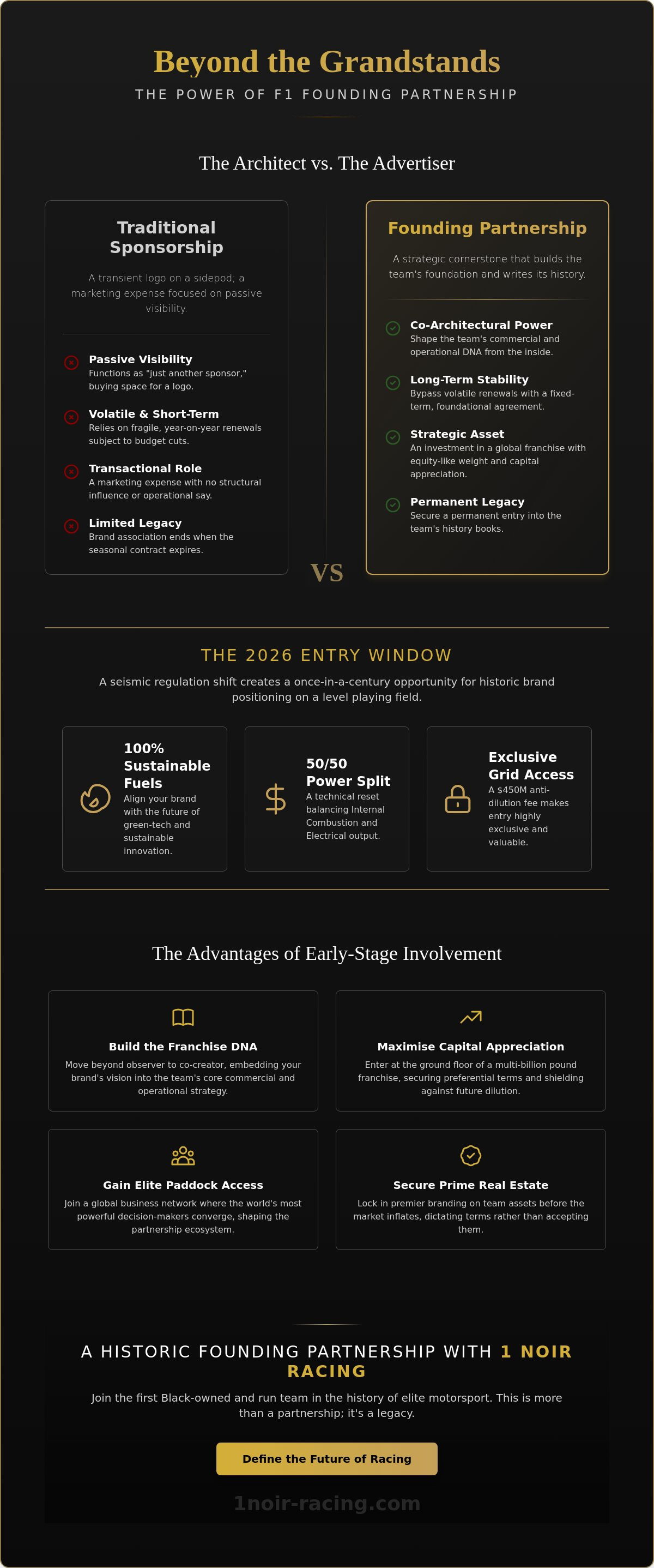
The distinction is stark. An advertiser buys audience access. An architect builds the platform that commands the audience. A founding partner operates in the latter category, influencing the team’s cultural and commercial foundation before the first wheel is ever turned in anger. Where a title sponsor gains brand visibility, a founding partner secures a strategic, often board-level, presence. They are involved in the critical decisions that define what the team stands for, who it partners with, and how it presents itself to a global market.
This role is for visionaries who understand that true influence is not measured in logos, but in legacy. It is the difference between putting a name on a car and putting a philosophy into the very heart of the organisation. In the simplest terms, an F1 team founding partner is a co-creator of the team’s commercial and operational DNA.
The 2030 Entry Window: A Rare Opportunity
Formula 1 does not open its doors often. The grid is a closed, ferociously competitive ecosystem. However, moments of regulatory upheaval create rare points of entry. The forthcoming 2030 regulation change represents precisely such a moment. With new power unit regulations and a potential expansion of the grid, the technical and financial playing field will be reset, offering the most viable opportunity in a generation for a new team to enter and compete credibly.
This is not merely an opportunity; it is a strategic chokepoint in the sport’s history. Securing a position as a founding partner for a 2030 entry is a move to capitalise on this disruption, establishing a foothold before the gates close once more. Understanding the nuances of this process is critical for any serious stakeholder exploring F1 team stakeholder opportunities.
The Strategic Advantages of Early-Stage Stakeholder Involvement
Entering at the ground floor of a new Formula 1 team is a venture capital play in the world’s most glamorous sport. The advantages for a founding partner are immense, extending far beyond the conventional benefits of sponsorship. It is about securing unparalleled access and influence at a preferential valuation, before the market corrects for a proven track record.
- Prime Asset Real Estate: Secure the most prominent and valuable branding and partnership assets on the car, team kit, and digital platforms before they are offered to the open market at inflated prices.
- Commercial Direction: Influence the team’s entire partnership ecosystem, shaping co-branded collaborations and strategic alliances that align with the founding partner's own commercial objectives.
- Unrivalled Access: Gain direct entry into the exclusive Formula 1 paddock, a global network of ultra-high-net-worth individuals, political figures, and C-suite executives.
- First-Mover Advantage: Capitalise on Formula 1’s explosive growth, particularly in the US market, by embedding your brand within a new team’s foundational story.
Equity and Asset Appreciation
Over the last decade, Formula 1 team valuations have skyrocketed. Driven by the budget cap, expanding global audience, and the success of Netflix’s Drive to Survive, F1 franchises are now viewed as appreciating assets with significant long-term growth potential. A founding partnership often includes preferential terms for future capital rounds or even a direct equity stake, transforming a marketing expense into a high-growth investment.
This is the ultimate insider opportunity: to become a stakeholder in a multi-billion-dollar industry at its inflection point. This is more than partnership; it is ownership of a cultural phenomenon. The landscape of Formula 1 partnership opportunities is evolving, and early-stage involvement offers the highest potential for exponential ROI.
Bespoke Integration and IP Rights
An established team is a finished product. A new team is a blank canvas. This presents a unique advantage for a founding partner. The opportunity exists to co-develop technical or commercial intellectual property, integrating the partner’s core business directly into the team’s operations. Imagine a technology company embedding its software in the team’s data analysis centre, or a luxury brand co-creating the team’s hospitality experience.
This deep integration allows a founding partner to shape the team’s public narrative from day one. You are not just joining a story; you are writing its first chapter. This level of bespoke involvement is impossible with established teams, whose identities and partnerships are already entrenched.
Founding Partner vs. Title Sponsor: A Commercial Comparison
The decision to become a founding partner or a title sponsor is a choice between two fundamentally different strategic objectives. Whilst both require significant financial commitment, their risk profiles, integration depth, and ultimate rewards are worlds apart. A title sponsor seeks to borrow a team's brand equity. A founding partner seeks to build it from the ground up.
The financial outlay for a founding partner is a foundational investment, whereas a title sponsorship is a recurring marketing expenditure. This brings a different level of security. Sponsors face the constant risk of non-renewal or being outbid year-on-year. A founding partner’s agreement is typically a fixed, long-term commitment that secures their position for the crucial initial phase of the team’s life, insulating them from market volatility.
The Decision Matrix for HNWIs and Corporates
For high-net-worth individuals, venture capitalists, and corporate leaders, the choice hinges on a single question: do you want to rent a platform or build a legacy?
- Objective: Is the goal short-term brand awareness (Sponsor) or long-term asset appreciation and influence (Founding Partner)?
- Risk Profile: Is the appetite for the calculated risk of a venture-style investment (Founding Partner) or the predictable, contractual nature of a media buy (Sponsor)?
- Driver: Is the motivation purely rational, based on marketing KPIs (Sponsor), or is it also emotional, driven by the desire to create something historic and lasting (Founding Partner)?
The legacy factor is the primary differentiator. No one remembers the third title sponsor of a mid-grid team. Everyone remembers who was there at the beginning.
Operational Influence and Governance
A title sponsor’s influence rarely extends beyond the marketing department. A founding partner, however, can command a voice in the team’s governance. This may include a seat on an advisory board, providing direct input on the team’s commercial strategy, key executive hires, and even its long-term vision.
Crucially, this includes shaping the team’s sustainability and ESG (Environmental, Social, and Governance) targets. For a partner committed to systemic change, this is an invaluable tool. It allows for the alignment of corporate values at an operational level, ensuring the team not only performs on the track but also leads on issues that matter. This is central to the mission of building the first Black-owned Formula 1 team, where purpose is inextricably linked to performance.
Structuring the Deal: From Capital Injection to Operational Influence
An F1 team founding partner agreement is a complex, bespoke contract reflecting the magnitude of the commitment. These are multi-year arrangements, typically spanning three to five years, designed to provide stability through the team’s formative period. The financial structure is often a staged investment model, with capital injections tied to key milestones such as FIA approval, factory completion, and grid confirmation.
However, the contribution is not purely financial. Founding partners are chosen for their strategic value. This can include non-financial contributions such as proprietary technology, industry-leading expertise, or an influential global network. The negotiation process is one of grounded honesty and absolute transparency, establishing a true partnership based on a shared vision and mutual trust.
Risk Mitigation in New Team Entries
Investing in a new venture carries inherent risk. In Formula 1, these risks are mitigated through a structured and rigorous process. Founding partners can protect their investment by building performance milestones into the agreement, ensuring that capital is deployed against measurable progress. The official approval processes of the FIA and Formula One Management (FOM) act as critical validation checkpoints, providing partners with the confidence that the team is viable, credible, and technically competent.
Ultimate security, however, comes from alignment. A successful partnership requires a deep synchronisation between the founder’s vision, the partner’s objectives, and the team’s technical and commercial roadmap. This ensures all stakeholders are pulling in the same direction, united by a single-minded pursuit of the end goal.
The Role of the Lead Entrepreneur
A new team is the manifestation of a founder’s vision. The lead entrepreneur—the central visionary like 1 NOIR Racing’s Anthony Danquah—is the driving force who galvanises partners, talent, and capital around a compelling mission. They are the guarantor of the team’s direction and the custodian of its values.
Founding partners do not simply invest in a business plan; they invest in this visionary leadership. They collaborate directly with the founder to drive the systemic change the team aims to achieve. This is a ‘Manifesto’ approach to team building, where every decision is a reflection of a core set of principles. It is this clarity of purpose that attracts the right partners and inspires the loyalty required to weather the challenges of competing at the pinnacle of motorsport.
1 NOIR Racing: The Case for a Historic Founding Partnership
The opportunity with 1 NOIR Racing is not just another new team entry. It is the chance to be a founding partner in the first Black-owned and run Formula 1 team in the sport’s more than 70-year history. This is a once-in-a-century legacy opportunity to correct a historic imbalance and redefine what is possible in global motorsport.
Our mission is built on a commitment to representation at every level: in the boardroom, in the engineering centre, and ultimately, in the cockpit. We are inviting high-level stakeholders, industry leaders, and visionary investors to move from the sidelines to the centre of the grid, co-authoring a new chapter for Formula 1. This is an invitation to be part of a movement that will resonate far beyond the racetrack.
Prestige with Purpose
1 NOIR Racing is where elite performance and a human-centric mission converge. We are building a team engineered to win, but our victory will be defined by more than just trophies. It will be measured by the doors we open and the conventions we shatter. In a traditionalist industry, being a disruptor holds immense commercial value. It attracts talent, engages new audiences, and creates a powerful, authentic brand narrative.
The countdown to the 2030 grid has begun. The window of opportunity to secure a founding position is now. This is a moment of profound urgency and historic potential.
Joining the 1 NOIR Journey
We are extending a direct invitation to sports personalities, industry experts, venture capitalists, and corporate leaders who recognise the power of this moment. This is a call to those who seek not only financial returns but also a lasting, positive impact on a global scale.
The process begins with a confidential discussion to explore our shared vision and the unique value you can bring to this historic endeavour. It is time to stop talking about change and start building it.
Secure your legacy: Enquire about Founding Partner opportunities.
Frequently Asked Questions
What is the difference between an F1 founding partner and a title sponsor?
A title sponsor purchases naming rights and high-visibility branding on a seasonal basis, treating it as a major marketing expense. An F1 founding partner is a strategic stakeholder who provides foundational capital and often has long-term influence over the team's commercial direction, governance, and culture. It is an architectural role, not an advertising one.
Can a founding partner have influence over driver selection or technical decisions?
Direct influence over technical specifications or driver selection is rare and typically remains with team principals and technical directors. However, a founding partner with a seat on an advisory board can influence the overall strategic direction, budget allocation, and criteria for key personnel, which indirectly shapes these outcomes.
Why is 2030 considered the best year to enter Formula 1 as a new team?
2030 is targeted as the next major regulatory overhaul for Formula 1, particularly concerning power units. These moments reset the competitive order and lower the barrier to entry for new teams, as established competitors lose some of their historical advantage. It creates a more level playing field for a new entrant to be competitive from the outset.
What are the typical contract lengths for an F1 founding partner?
Founding partner agreements are long-term commitments designed to provide stability during a team's crucial formative years. They typically span a multi-year horizon, often between three to five years, with options to extend or convert the partnership into a different stakeholder role as the team matures.
How does 1 NOIR Racing’s status as a Black-owned team impact its partnership value?
It creates a unique and powerful value proposition. Partners are not just aligning with a racing team but with a historic, purpose-driven mission that addresses a major representation gap in global sport. This offers unparalleled brand differentiation, resonates with modern consumer values (ESG), and attracts global media attention, delivering value far beyond traditional on-car branding.
Is equity always part of a founding partner agreement in Formula 1?
Not always, but it is a significant possibility and a key differentiator from standard sponsorship. Agreements can be structured to include direct equity, warrants, or preferential terms for participation in future funding rounds, allowing the partner to share in the team's long-term asset appreciation.
What happens if a new team entry is not granted a spot on the grid?
Founding partner agreements are structured with clear milestones and contingencies. Financial commitments are typically staged and tied to key approvals, such as the FIA granting an official entry. If the entry is not secured, clauses within the agreement would dictate the terms for the return or reallocation of invested capital, mitigating risk for the partners.
How do founding partners benefit from F1’s global sustainability (ESG) goals?
By being involved at the foundational level, partners can help shape a new team’s ESG strategy from day one, rather than trying to influence an established organisation. This allows them to embed their own corporate sustainability goals into the team’s DNA, from its carbon footprint to its diversity and inclusion programmes, creating an authentic and powerful ESG narrative.