

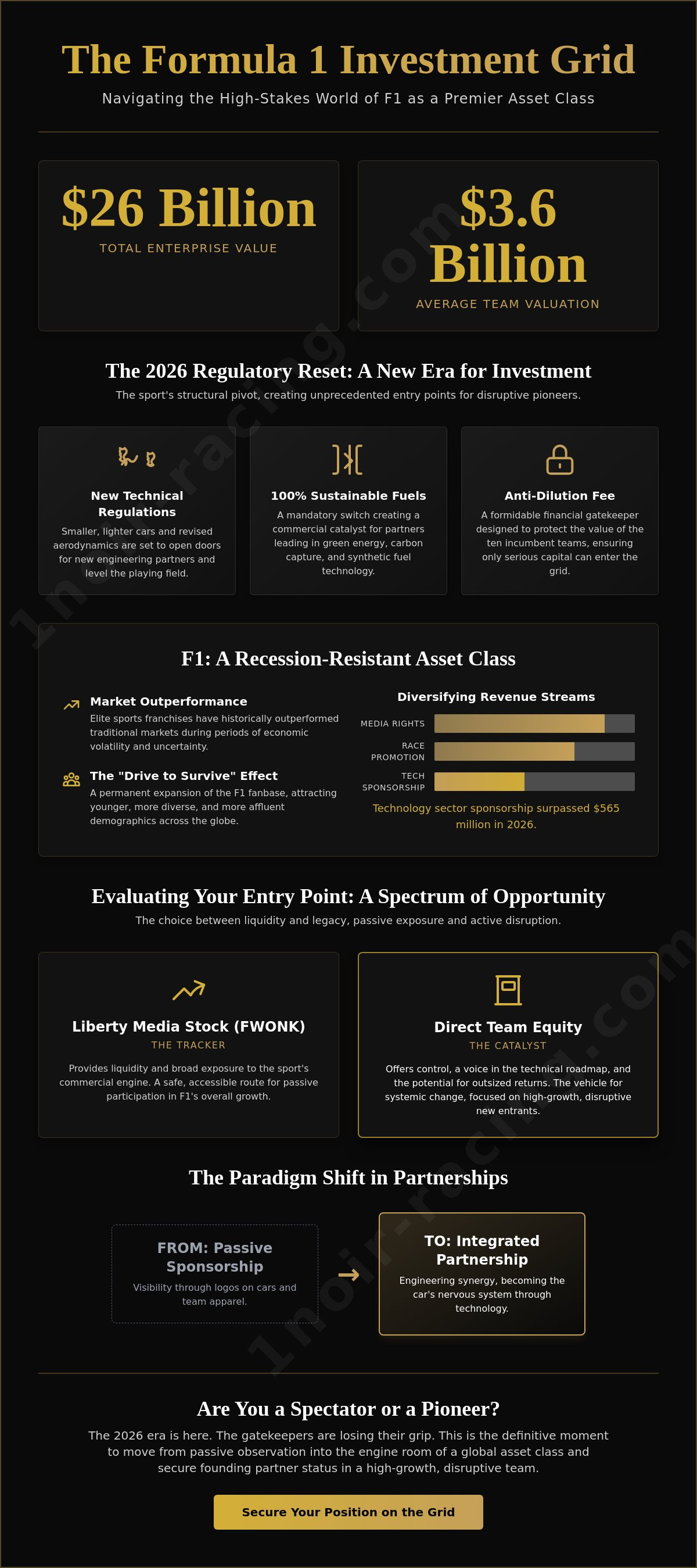
Why settle for the sidelines when the average F1 team valuation has surged to $3.6 billion? The sport isn't just a spectacle; it's a closed shop being forced open by the 2026 regulations. You've likely watched the enterprise value of Formula 1 climb past $26 billion whilst wondering how to secure a seat at the table. This is the definitive Formula 1 investment opportunity. It's a chance to move beyond passive observation and into the engine room of a global asset class. The gatekeepers are losing their grip. The narrative is shifting.
You know the barriers are high. You've felt the opacity of team valuations and the frustration of hidden routes to securing founding partner status. It's an elite world designed to keep you out. We understand that frustration. This guide changes the game. We'll dismantle the barriers. We'll map the entry points for equity and identify the disruptive teams poised to redefine the grid. You'll gain a clear framework for evaluating F1 as an asset class; ensuring your capital aligns with prestige and purpose. The 2026 era isn't coming. It's already here. It's time to decide if you're a spectator or a pioneer.
Key Takeaways
- Analyse the 2026 regulatory reset to exploit the structural openings left by established incumbents.
- Navigate the Formula 1 investment opportunity by balancing private equity against long-term technical infrastructure.
- Decode the scarcity principles and revenue-sharing models that protect the valuation of the grid’s most exclusive assets.
- Capitalise on the commercial premium of diverse leadership; where representation becomes a tangible competitive advantage.
- Establish a rigorous due diligence framework to identify and secure founding partner status in high-growth, disruptive teams.
The Landscape of Formula 1 Investment in 2026
The era of the billionaire’s plaything is dead. In its place stands a sophisticated, high-velocity asset class. It's a fusion of media rights, proprietary technology, and global brand equity. This isn't just about racing; it's about owning a piece of a $26 billion enterprise. For those seeking a Formula 1 investment opportunity, the 2026 season represents a structural pivot. It's the moment when the barriers to entry meet a radical regulatory reset. The old guard is comfortable. They shouldn't be.
Traditional sponsorship is fading into obsolescence. Logos on sidepods are no longer enough for the modern titan. We're seeing a shift toward strategic equity partnerships. Investors don't want visibility; they want ownership. They want a seat at the table where decisions about technical infrastructure and commercial expansion are made. This Formula 1 overview highlights how the sport has transitioned from a European circuit to a global commercial powerhouse. The narrative is no longer about who wins on Sunday; it's about who owns the data on Monday.
The 2026 Expansion Era
The new Concorde Agreement has rewritten the financial DNA of the paddock. It governs how teams profit and how new players enter. The 2026 regulations introduce smaller, lighter cars and a mandatory switch to 100% sustainable fuels. This isn't just a technical change. It's a commercial catalyst. It opens doors for technical partners who lead in green energy and carbon sequestration. However, the "anti-dilution" fee remains a formidable gatekeeper. It's a price for entry designed to protect the value of the existing ten teams. It ensures that only those with serious capital and a vision for systemic change can cross the threshold. The grid is saturated, yet the demand for new, disruptive entries has never been higher.
F1 as a Recession-Resistant Asset
Elite sports franchises have historically outperformed traditional markets during economic volatility. F1 is no exception. The "Drive to Survive" effect has transformed the audience. We're seeing younger, more diverse, and more affluent demographics across the globe. This isn't a temporary surge; it's a permanent expansion of the fan base. Revenue streams are diversifying. Media rights and race promotion remain dominant, but technology sector sponsorship has already surpassed $565 million in 2026. Every team on the grid is now trending towards profitability. In 2026, the current average F1 team valuation floor has solidified at $1.5 billion, whilst the mean valuation has reached an unprecedented $3.6 billion.
Evaluating Entry Points: Equity, Sponsorship, and Venture Capital
Watching from the grandstands is an expense. Owning the grid is an asset. For the serious investor, a Formula 1 investment opportunity is not a monolithic concept. It is a choice between liquidity and legacy. It is the difference between passive exposure and active disruption. Will you be a passenger in the sport's growth, or will you drive its evolution? The entry points are narrowing. The price of hesitation is rising.
Direct Team Equity vs. Liberty Media Stock
Public markets offer the illusion of participation. Investing in Liberty Media (FWONK) provides liquidity and broad exposure to the sport's commercial engine. It's safe. It's accessible. But it lacks the raw power of direct team equity. Direct ownership offers control. It offers a voice in the technical roadmap. Whilst established teams command staggering F1 team valuations, they often come with rigid cultures and high premiums. New entrants represent the high-growth frontier. They are the vehicles for systemic change and outsized returns. One is a tracker; the other is a catalyst.
Venture capital is no longer an outsider in the paddock. It is the lifeblood of the technical infrastructure. From AI-driven race strategy to advanced material science, VC firms are funding the tools that win championships. They don't just buy into teams; they build the ecosystems that make teams successful. This is where corporate partnerships are evolving. The era of the "logo on the car" is ending. It's being replaced by integrated technology partnerships. Your company doesn't just sponsor the car; it becomes the car's nervous system. It's about engineering synergy, not just brand visibility.
The Mechanics of a Founding Partner Deal
Founding Partner status is the most exclusive tier of the sport. It's a rare window that opens only during a team’s formation phase. What does it entail? It's more than equity. It's a seat at the leadership table. It's the right to shape the team’s identity from day one. These deals often involve long-term vesting structures and specific governance rights. They are designed for those who want to be part of a mission, not just a balance sheet. Are you ready to help pioneer the first Black-owned and run F1 team? This is where purpose meets profit. It requires a commitment to excellence and a refusal to accept the status quo. The routes are opaque for a reason. Exclusivity is the point.
The Valuation Surge: Why F1 Teams are Elite Assets
Scarcity is the ultimate leverage. In a world of infinite digital assets, a physical slot on the grid remains the rarest commodity in global sport. This is the bedrock of the Formula 1 investment opportunity. It is a closed system. Ten teams. That's it. This scarcity creates an absolute price floor that competitors in other sports simply cannot replicate. When supply is fixed and global demand is exploding, valuation becomes a matter of when, not if.
The revenue model has matured. Teams no longer survive on the whims of a single benefactor. They thrive on a global media pot that distributed $1.40 billion to the grid in 2025. Institutional investors have noticed. Private equity firms have already demonstrated the exit potential; entering during periods of transition and exiting at multiples that rewrite the rules of sports finance. We are witnessing surging F1 valuations because the structural risk has been systematically dismantled. The "money pit" narrative is dead. Profitability is the new standard.
The Impact of the F1 Cost Cap
Spend was once the only metric of success. The cost cap changed everything. It forced a transition from outspending to out-organising. By capping operational expenditure, the sport has turned what were once liabilities into lean profit centres. This fiscal discipline doesn't just protect the balance sheet. It levels the field. It ensures that a new, disruptive Formula 1 investment opportunity can compete with legacy giants without needing a bottomless treasury. Efficiency is the new horsepower. Organisations that can innovate within constraints will always outperform those that simply throw capital at a problem.
Global Reach and Brand Equity
Imagine a billboard that moves through 24 countries. F1 is a global stage for the luxury sector. The ROI is found in the prestige of the paddock and the precision of the engineering. This isn't about impressions. It's about association with the pinnacle of human achievement. F1 teams aggressively leverage technology transfer; applying trackside aerodynamic and data processing breakthroughs to automotive, medical, and aerospace sectors to diversify revenue and inflate enterprise value. Success on the track translates to dominance in the laboratory. It's a virtuous cycle of brand equity and technical brilliance that secures a team's place as an elite asset.
The Purpose-Led Premium: Diversity as a Competitive Advantage
The grid is a mirror of the past. It's time to reflect the future. For decades, Formula 1 leadership has remained a closed circle, an echo chamber of the same perspectives and historical biases. This isn't just a social oversight; it's a massive commercial blind spot. In the modern era, a Formula 1 investment opportunity must be measured by more than just lap times. It must be measured by its ability to resonate with a global, diverse audience that the old guard has consistently ignored. Representation is the new aerodynamics. It reduces friction in market entry and accelerates brand loyalty.
Diversity is a commercial catalyst. It drives innovation by bringing fresh, unconditioned thinking into the engineering room and the boardroom. The data supports this shift. With a 68% increase in sponsorship spending from US-based companies since 2023, the sport is no longer a European enclave. New fans are younger, more diverse, and they demand more than just a fast car. They demand a mission. Purpose-driven teams aren't just chasing trophies; they're chasing systemic change. This creates an "Impact ROI" that traditional teams cannot replicate. It's about owning the narrative of the future, not just the legacy of the past.
Disrupting the Traditional F1 Narrative
The arrival of the first Black-owned Formula 1 team represents the most significant disruption to the sport's social fabric in a generation. This isn't a symbolic gesture. It's a strategic strike against the status quo. For ESG-focused investors, this is the ultimate "first-of-its-kind" venture. It offers a unique entry point into an elite industry whilst simultaneously addressing the systemic lack of representation in technical leadership. Innovation thrives on difference. When you change the people in the room, you change the questions being asked. That's how you out-organise the competition.
Attracting Untapped Corporate Capital
Corporate capital is pivoting. Brands are no longer satisfied with being "travelling billboards" for legacy teams. They want alignment with values. They want to be at the centre of a cultural movement. Technology sector sponsorship has already surpassed $565 million in 2026, driven by companies that value disruption and visionary leadership. By positioning your investment within a team that champions diversity, you tap into these emerging revenue streams. You reach fans in emerging markets who have never seen themselves reflected on the podium. This is how you secure a sustainable competitive advantage in a crowded market. It's time to lead the charge. Join us in building the future of inclusive motorsport and secure your stake in a legacy that matters.
Securing Your Position: The Path to Founding Partner Status
Opportunities of this magnitude don't wait for the consensus of the cautious. They're seized in the silence before the storm. The 2026 regulatory reset has created a finite window. Once the first lights go out in the new era, the entry price will have already doubled. This is the ultimate Formula 1 investment opportunity. It requires more than capital. It requires the foresight to identify a team before it becomes a household name. You must look beyond the established paddock and toward the disruptors currently building their technical foundations. The gatekeepers are watching. The window is closing.
Due diligence in this sector isn't merely a financial exercise. It's a study of leadership and technical roadmaps. Does the team have the vision to out-organise the giants? Is the leadership prepared to challenge systemic barriers whilst maintaining a relentless focus on performance? You aren't just buying into a race team. You're buying into a mission. The timing is non-negotiable. Commitment must happen now to ensure your influence is baked into the team's DNA. Waiting for a public announcement is simply waiting for a higher premium.
Becoming a Part of History
There's a stark difference between being a sponsor and being a stakeholder. A sponsor pays for space. A stakeholder owns the vision. By participating in the development of the first Black-owned and run F1 team, you aren't just placing a logo on a car. You're rewriting the history of global motorsport. This is a chance to leverage your personal brand or corporate clout within the most exclusive paddock in the world. It's about prestige with a purpose. It's about being able to say you were there when the narrative shifted. Legacy isn't bought on the open market. It's built through strategic, early-stage collaboration.
Next Steps for Strategic Investors
Your investment thesis must be as precise as the engineering it funds. It should reflect an understanding of the sport's move toward sustainable fuels and the commercial power of a diverse fan base. Industry experts play a vital role here. They help shape a new team entry that's both technically sound and commercially formidable. The path to the grid is narrow. The gatekeepers are many. But for those who move with speed and conviction, the rewards are unparalleled. If you're ready to move from the sidelines to the inner circle, the time for observation is over. Contact 1 NOIR Racing today to discuss high-level collaboration and secure your position at the vanguard of the 2026 era. The grid is waiting. Will you lead or follow?
The Future Belongs to the Disruptors
The grid is changing. The old barriers are crumbling. We've explored how the 2026 regulatory reset and the scarcity of grid slots have transformed F1 teams into elite, recession-resistant assets. We've seen how purpose-led leadership creates a commercial premium that legacy teams simply can't match. This is the ultimate Formula 1 investment opportunity. It's a chance to align your capital with a mission that's both technically superior and socially transformative.
Founded by British entrepreneur Anthony Danquah, 1 NOIR Racing is positioned as the first Black-owned and run F1 team. We aren't just entering the sport; we're redefining its DNA. As we target the 2026 grid expansion window, the time for passive observation has passed. Will you watch history from the grandstands, or will you help write it? The window for founding influence is narrow. The potential for legacy is infinite. Partner with 1 NOIR Racing: Secure Your Legacy in F1. Join us at the vanguard of a new era. The race for 2026 has already begun.
Frequently Asked Questions
Is it possible to buy a stake in an existing Formula 1 team?
Yes. Minority stakes are frequently traded behind closed doors amongst institutional investors and sovereign wealth funds. Private equity firms have increasingly targeted existing teams to capitalise on the sport's rapid growth. It's a closed shop, but the right capital always finds a key. These transactions allow teams to fund infrastructure whilst providing investors with exposure to a high-growth asset class.
What is the minimum investment required for an F1 partnership?
Entry costs vary based on the level of involvement. Whilst standard sponsorship deals might begin in the low millions, a Formula 1 investment opportunity involving equity or Founding Partner status requires a commitment in the tens or hundreds of millions. Precision in capital allocation is paramount. The price of entry is the price of exclusivity.
How do new teams enter the Formula 1 grid in 2026?
New entrants must navigate a formal FIA application process and adhere to the strictures of the Concorde Agreement. This includes proving technical competence and paying a substantial anti-dilution fee to the existing ten teams. The 2026 technical reset provides the critical window for these applications. It is a high-stakes hurdle designed to ensure only the most serious contenders reach the grid.
What is the difference between an F1 sponsor and a team owner?
Control is the defining factor. A sponsor pays for brand visibility and marketing rights; an owner holds equity and dictates the strategic roadmap. Sponsors rent space on a car whilst owners build the car's future. Ownership provides a share of the global media pot and the ultimate benefit of asset appreciation. One is a transaction. The other is a legacy.
Why are F1 team valuations increasing so rapidly?
Scarcity and profitability are driving the surge. The cost cap has turned teams from bottomless money pits into lean profit centres. With only ten teams and a global audience of half a billion, the demand for ownership far outstrips supply. It is a simple, brutal equation of market economics. As revenue streams diversify, the value of a grid slot continues to climb.
Can individuals invest in Formula 1 or is it only for corporations?
Participation is possible for both. Individuals can invest through public stocks like Liberty Media or by joining private investment syndicates. Direct team equity is typically reserved for those who provide strategic value beyond mere capital. It is a world of elite collaboration. Corporations seek technical synergy; individuals seek prestige and historical impact.
What makes 1 NOIR Racing a unique investment opportunity?
We are not just building a car; we are building a movement. 1 NOIR Racing represents a Formula 1 investment opportunity that bridges the gap between elite performance and social representation. As the first Black-owned and run team, it is a commercial catalyst that resonates with a new, diverse generation of fans. This purpose-driven model creates a unique competitive edge in a crowded market.
How does the F1 cost cap affect investor returns?
The cost cap acts as a safety net for capital. By capping operational spend, the sport ensures that teams don't burn through their valuations in a technical arms race. It enforces financial discipline and guarantees that success is driven by organisational efficiency rather than the size of a treasury. This transition to a sustainable business model makes team ownership a more attractive, long-term asset.