
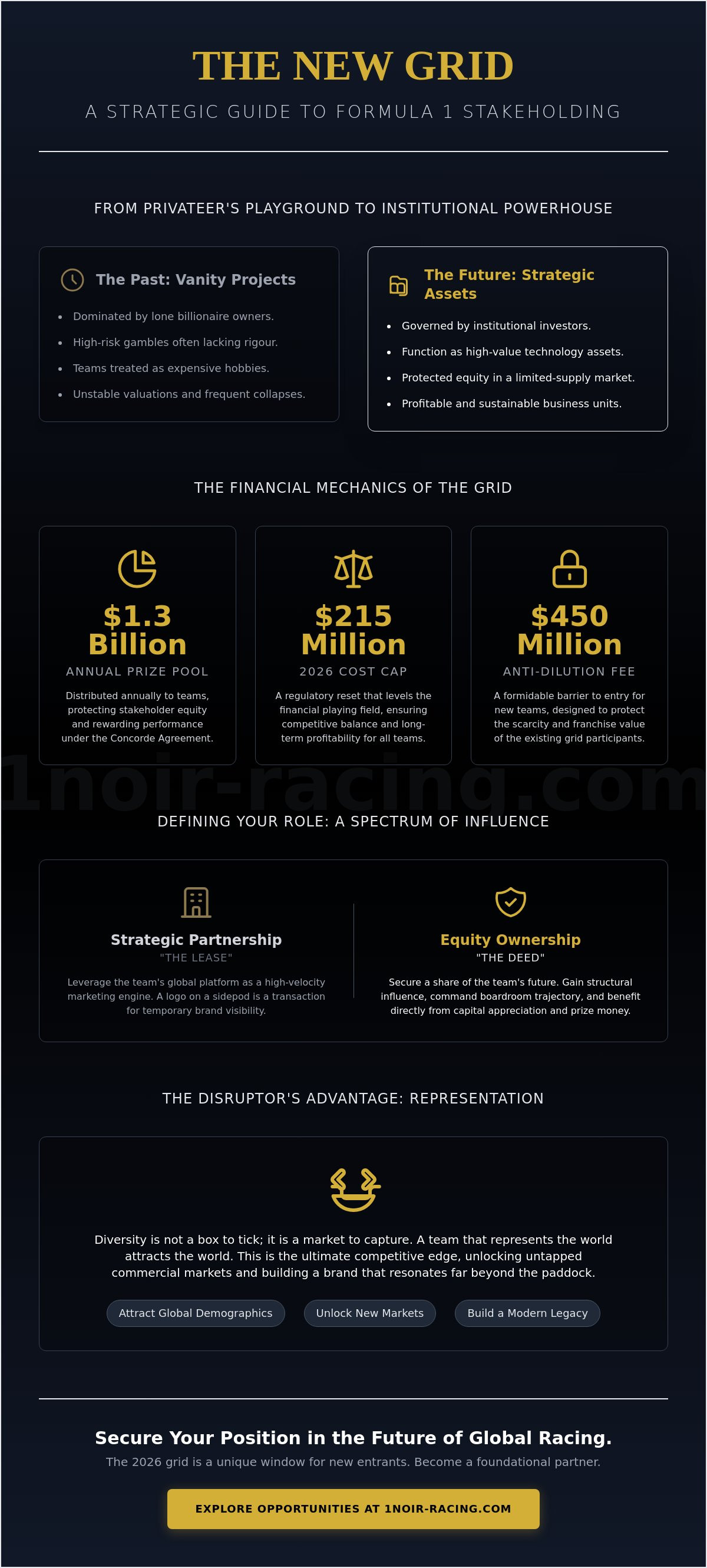
The era of the vanity project is dead. Formula 1 is no longer a playground for the bored billionaire; it is a high-stakes arena for systemic transformation. You recognise the prestige of the grid. You see the $1.3 billion prize pool distributed to teams. Yet, the path to entry remains intentionally obscured by a $450 million anti-dilution fee and complex technical regulations. Identifying the right F1 team stakeholder opportunities is not just about capital. It is about influence. It is about impact. It is about refusing to be a silent partner in a sport that demands a loud, clear vision.
We understand the frustration of facing opaque barriers and the fear of financial dilution without strategic control. This guide serves as your manifesto for entry. We will break down the mechanics of the 2026 Concorde Agreement and the $215 million cost cap. You will learn to navigate the different stakeholder roles and identify the strategic value of a new team entry. This is your roadmap to securing a position in a high-growth asset that defines the future of global racing. The grid is waiting for its next pioneer. Let's begin.
Key Takeaways
- Recognise the transition from privateer hobbies to institutional powerhouses where teams function as high-value technology and marketing assets.
- Master the distinctions between equity ownership and strategic partnerships to ensure your capital secures genuine influence rather than silent participation.
- Leverage the 2026 regulatory reset as a unique window to enter the grid on a competitive, level playing field.
- Identify the most significant F1 team stakeholder opportunities by aligning with transformative projects that offer both financial growth and historical legacy.
- Follow a strategic roadmap to assess team missions and secure your position as a foundational partner in the future of the sport.
Understanding Formula 1 Team Ownership in the Modern Era
Formula 1 is no longer just a sport. It's a closed-loop economy. It's a high-velocity ecosystem of intellectual property and global narrative. The modern F1 team is a technology incubator disguised as a racing outfit. It's a marketing engine that never sleeps. It's a fortress of strategic value. The transition from the romantic privateer to the institutional powerhouse is complete. This shift has redefined the landscape of F1 team stakeholder opportunities, turning what was once a high-risk gamble into a high-prestige asset class.
The lone billionaire owner is a relic of the past. Today, the grid is dominated by institutional investors and diversified consortia. Why? Because the "Franchise Model" introduced by Liberty Media has stabilised team valuations. Scarcity drives the market. The Concorde Agreement acts as the legal bedrock for this stability. It protects stakeholder equity. It defines the rules of engagement. It ensures that every team is a protected participant in a billion-dollar industry. The history of Formula One constructors shows us the graveyard of those who failed to adapt. They relied on passion; they lacked the institutional rigour required for the modern era.
The Shift from Privateers to Billion-Dollar Assets
The $215 million cost cap for the 2026 season has fundamentally changed the financial physics of the sport. It turned bottomless pits of debt into profitable business units. Valuations are soaring whilst the entry grid remains strictly limited. When you look at F1 team stakeholder opportunities today, you aren't just looking at a sponsorship deal. You're looking at equity in a limited-supply asset. Securing "Founding Partner" status in a new team entry is the ultimate strategic move. It allows you to bypass the astronomical premiums of established teams whilst capturing the ground-floor growth of a new legacy.
Why Representation is the New Competitive Edge
Diversity isn't a box to tick. It's a market to capture. The current grid is monolithic. It often ignores vast global demographics that are hungry for engagement. A team that represents the world attracts the world. This is the disruptor's advantage. Fresh perspectives attract a younger, more global demographic that traditional teams struggle to reach. Positioning a team as a social and cultural pioneer isn't just about ethics; it's about unlocking untapped commercial markets. It's about building a brand that resonates far beyond the paddock. In the high-stakes world of elite racing, being different is the only way to be first.
The Mechanics of F1 Stakeholder Structures
A logo on a sidepod is a transaction. It is temporary. It is fleeting. True involvement in the pinnacle of motorsport requires a deeper, more structural integration. If you want to move beyond the role of a spectator with a pass, you must understand the architecture of F1 team stakeholder opportunities. The grid is no longer built on simple handshakes. It's built on complex layers of equity, strategic alignment, and long-term brand legacy. You aren't just buying space. You are buying influence.
Distinguish between the lease and the deed. Corporate sponsorship is a lease; it buys you visibility for a season. Equity ownership is a deed; it buys you a share of the future. With F1 team valuations reaching multi-billion pound heights, the entry point for stakeholders has shifted from charity to high-yield investment. Lead investors command the boardroom, steering the technical and commercial trajectory. Minority stakeholders, whilst holding less voting power, gain access to an elite networking biosphere that exists nowhere else on earth. For those seeking a foundational role, becoming a part of a new entry offers the chance to define a team's DNA from day one.
Equity vs. Partnership: Defining Your Role
Direct equity is the pursuit of capital appreciation. You own a piece of the team. You benefit from the $1.3 billion prize pool distributed annually. Commercial partnerships, conversely, are about leveraging the platform. You use the car as a global billboard to accelerate your own brand's growth. Strategic involvement sits in the middle. It is for the technical titans. If you provide the engineering, the logistics, or the software that makes the car faster, you are a component of the performance itself.
The Rise of Sports Venture Capital in Motorsport
Private equity firms no longer view F1 as a hobby. They see alternative assets with massive upside. The 2026 cost cap of $215 million has capped the risk, but the revenue potential remains uncapped. This creates a "Ground Floor" advantage for new entrants. Investing during the development phase allows stakeholders to capture the value spike that occurs the moment the car first hits the tarmac. It is a balance of hard financial ROI and the soft power of the paddock. These F1 team stakeholder opportunities represent the intersection of prestige and profit.
Navigating the 2026 Grid: A Unique Window for New Entrants
The 2026 season is not just another year on the calendar. It's a seismic shift. It's a total technical reset. For the first time in a generation, the technical slate is wiped clean. New power units. New aerodynamics. New chassis. This is where the historical advantage of the establishment evaporates. Every team starts from zero. This reset creates the most fertile ground for F1 team stakeholder opportunities in modern history. The gap between the front and the back of the grid is about to be compressed. The question is not if the order will change, but who will lead the new one.
The "closed shop" narrative is a defensive wall. It's built by those already inside who fear dilution. They fear disruption. Yet, the FIA recognises that true value is found in growth and representation. To enter the grid, a team must prove more than financial solvency. It must prove systemic necessity. Examining Formula 1's 2025 financial landscape reveals why the barriers are so high. A one-time anti-dilution fee of $450 million is the price of admission. It is a steep climb. But for the strategic stakeholder, it is a protected investment in a limited-supply market. Scarcity is the engine of value.
New Regulations and the Concorde Agreement
The 2026 ruleset is designed to punish inefficiency. The cost cap is set at $215 million. This prevents the traditional arms race. It forces teams to win with intellect rather than just raw capital. Under the new Concorde Agreement, the commercial rights are locked. The entry window is narrow. Stakeholders must share the $450 million anti-dilution cost now to secure their equity before the next cycle of commercial negotiations begins. If you wait for the first race to start, you've already missed the primary value spike. Timing is the difference between a partner and a pioneer.
The Strategic Value of a Pre-Launch Entry
Pioneers own the narrative. By entering as a foundational stakeholder, you don't just observe the culture; you build it. You select the leadership. You define the mission. Early-stage media coverage treats founders as visionaries. They aren't just names on a list. They are the architects of a new era. This is the moment to secure a legacy that will be written into the history books of the sport. The 2026 window represents the most significant opportunity for grid entry and stakeholder positioning in over a decade.
How to Become a Formula 1 Team Stakeholder: A Strategic Roadmap
Entry is not an accident. It is an architecture. You don't just buy in; you align. To secure a place amongst the elite, you must move with precision. The roadmap to F1 team stakeholder opportunities begins with an uncompromising assessment of your own objectives. Are you building a legacy? Are you seeking global brand acceleration? Is this a clinical pursuit of financial return? Without clarity of purpose, your capital is merely noise. Define the impact you intend to make before the first contract is drafted.
Once your mission is clear, the process follows a rigorous sequence of execution:
- Identify Strategic Alignment: Locate a team whose core values mirror your own corporate or personal philosophy.
- Technical Audit: Scrutinise the aerodynamic roadmap and engine supply agreements for long-term viability.
- Commercial Validation: Review the pipeline of existing foundational partners to ensure a robust business ecosystem.
- Formalise the Contribution: Define the structure of capital calls, equity grants, or partnership tiers.
- Execute Activation: Integrate your specific brand identity or technical expertise into the team's global launch.
Success in this arena requires more than a bank balance. It requires a seat at the table. If you are ready to lead rather than follow, apply to join the 1 NOIR Racing mission today and secure your place in history.
Assessing Strategic Alignment and Values
Purpose-driven teams like 1 NOIR Racing provide a unique ESG advantage that traditional outfits cannot match. They offer a narrative of systemic change. When evaluating F1 team stakeholder opportunities, look beyond the wind tunnel. Look at the leadership. Do they have the vision to disrupt a monolithic industry? You must ensure your stakeholder role provides the specific level of access you require, whether that involves technical insight or boardroom influence. Alignment is the only shield against the dilution of your strategic impact.
The Due Diligence of High-Stakes Motorsport
A financial audit is only half the story. In the paddock, technical viability is the true currency of trust. You must analyse technical partnerships and engine supply agreements with the same rigour as a balance sheet. Review the commercial pipeline. Who else is in the room? F1 due diligence requires both financial and technical audit to ensure the team can actually deliver on its competitive promises. Scrutinise the foundational backers. A team is only as strong as the network that supports its development phase.
1 NOIR Racing: Your Entry into a Historic Legacy
The grid is full. The establishment is comfortable. But the establishment is stagnant. 1 NOIR Racing exists to shatter the silence. We are building the first Black-owned and Black-run team in the history of Formula 1. This isn't a vanity project. It's a structural intervention. Amongst all current F1 team stakeholder opportunities, this project stands alone as the most significant entry for the 2026 season. We aren't asking for permission to join a club. We are creating a new one. This is about more than racing; it's about the right to lead.
This is your moment to contribute to a manifesto for systemic change. We are merging elite performance with a deeply human mission. The roadmap to the 2026 grid is already in motion. We have identified the gaps. We have secured the vision. Now, we are finalising the foundational stakeholders who will define this legacy. You have seen the numbers. You know the valuations. Now, see the purpose. This is where prestige meets progress.
Why the First Black-Owned Team is a Strategic Asset
Authentic representation is a commercial powerhouse. By creating a team that reflects a global demographic, we unlock an underserved audience that traditional teams have ignored for decades. This is the "First-Mover" advantage. You have the chance to own a piece of a historic milestone that will never be repeated. 1 NOIR Racing bridges the gap between the precision of the paddock and the power of social impact. It turns an investment into a movement. It turns a partner into a pioneer. Why settle for a logo on a car when you can own a chapter of history?
Securing Your Place on the 2026 Grid
The window is closing. We are currently identifying founding partners and equity investors who understand the weight of this opportunity. This is not for the passive observer. It is for the industry expert and the visionary capital partner who wants real influence. To begin the process, we invite high-level partners to schedule an initial consultation. This provides access to our confidential investor deck and technical roadmap. To understand the full scale of our ambition, read our pillar on The First Black-Owned Formula 1 Team: A New Era for Global Motorsport.
The 2026 technical reset is the starting gun. These F1 team stakeholder opportunities will not remain open once the first chassis is fired up. The barrier to entry is high because the reward is eternal. Secure your position. Build the legacy. Change the sport forever. We don't just want your capital. We want your conviction.
Claim Your Stake in Racing History
The technical reset of 2026 is a finite window. It's a moment where the establishment is vulnerable and the bold are rewarded. You've seen how the franchise model has stabilised valuations. You understand that equity is the only path to real influence. Now, you must decide if you will watch the future or build it. These F1 team stakeholder opportunities are no longer just about financial returns. They are about the power to redefine global sport through representation and excellence.
Founded by Anthony Danquah, 1 NOIR Racing is positioned for the 2026 grid entry as the first Black-owned and run F1 team initiative. This is a manifesto in motion. It is a strategic asset for those who demand both prestige and purpose. Don't wait for the lights to go out on this opportunity. The time for observation has passed. The time for leadership is now. Register your interest in the 1 NOIR Racing stakeholder programme today. Join us at the front of the grid. Let's make history together.
Frequently Asked Questions
How much does it cost to become an F1 team stakeholder?
Entry costs are dictated by the level of involvement, but the 2026 anti-dilution fee for new teams is set at $450 million. This one-time payment protects the prize money share of existing teams. Stakeholders must also account for the $215 million annual cost cap. It's a high-entry-barrier industry where capital buys a seat in a protected, high-growth ecosystem.
Can an individual invest in a Formula 1 team or only corporations?
Individuals participate in team ownership through private equity consortia or as high-net-worth strategic partners. Whilst manufacturers dominate the narrative, private investors often hold significant minority stakes. These F1 team stakeholder opportunities allow individuals to capture the sport's soaring valuation without the burden of sole operations. It's about access to an elite networking biosphere and long-term capital appreciation.
What is the difference between a sponsor and a stakeholder in F1?
A sponsor pays for marketing visibility whilst a stakeholder owns a portion of the team's equity or strategic direction. Sponsorship is a transient contract; it ends when the term expires. Stakeholders hold a permanent interest in the team's valuation and the $1.3 billion annual prize pool. They're foundational partners in the team's legacy and financial trajectory.
How do new teams like 1 NOIR Racing get a spot on the F1 grid?
New teams must pass a rigorous FIA selection process that scrutinises financial, technical, and social value. This involves paying the $450 million anti-dilution fee and proving a contribution to the sport's global reach. 1 NOIR Racing leverages its mission of representation to provide a unique value proposition. This systemic necessity is what proves a team's worth to the regulators.
What are the benefits of being a founding partner in an F1 team?
Founding partners secure the "First-Mover" advantage, capturing equity at the ground floor before team valuations escalate further. They influence the team's culture, leadership, and technical roadmap from the beginning. This role offers unparalleled brand integration and the prestige of being an architect of a new legacy. You aren't just joining a team; you're defining its DNA.
Is F1 investment a high-risk venture?
Formula 1 was once volatile, but the franchise model and the $215 million cost cap have stabilised the industry. Teams are now profitable business units with multi-billion pound valuations. Risk is mitigated by the limited supply of grid spots and the guaranteed revenue from the Concorde Agreement. It's a strategic move into a protected, high-prestige asset class.
How does the budget cap affect new team stakeholders?
The $215 million cost cap ensures that technical efficiency, not infinite spending, dictates success on the grid. For stakeholders, this means their capital is used to out-think the competition rather than out-spend them. It protects your investment from the unsustainable financial arms races of the past. These F1 team stakeholder opportunities are built on a foundation of sustainable business logic and competitive parity.
What is the role of the FIA in approving new team ownership?
The FIA acts as the gatekeeper, conducting exhaustive due diligence on the technical and financial background of any potential owner. They ensure every entrant adheres to the strict standards of the Concorde Agreement. Approval depends on a team's ability to enhance the sport's global prestige and commercial viability. They protect the grid's integrity by ensuring only the most capable visionaries enter.