
Formula 1 is a closed circle. A world of immense speed, capital, and influence, historically accessible to a select few. Yet, the grid is not static. It breathes, it shifts, and on rare occasions, it expands. Securing a new Formula 1 team entry is more than a sporting achievement; it is a monumental undertaking in finance, engineering, and politics. It is the process of creating a multi-hundred-million-dollar technology company from the ground up, designed to compete at the absolute apex of global motorsport.
This is not a theoretical exercise. The 2026 regulatory overhaul cracked the door open for new contenders, but the true opportunity lies in the horizon beyond. For visionary investors and strategists, the focus is now on the next Concorde Agreement and the subsequent entry window, likely post-2030. This guide deconstructs the rigorous process, unpacks the immense financial barriers, and reveals the historic opportunities that define the path to joining the world's most exclusive sporting club.
The Changing Grid: Understanding the New Formula 1 Team Entry Process
Gaining entry to the Formula 1 grid is not a simple application. It is an exhaustive, multi-stage process governed by the sport’s two key powers: the Fédération Internationale de l'Automobile (FIA), the regulatory body, and Formula One Management (FOM), the commercial rights holder. This process is designed to protect the championship's integrity, stability, and commercial value, ensuring any new entrant adds value rather than diluting the field.
- The "Expression of Interest" (EOI): The journey begins when the FIA formally opens a window for potential new teams. Aspirants must submit a detailed EOI, which serves as a preliminary dossier outlining their project's credibility, technical prowess, and financial backing.
- Technical and Financial Scrutiny: The EOI is not a statement of intent; it is a comprehensive business plan. The FIA assesses a candidate's technical capabilities, facilities, key personnel, and, most critically, their financial stability to sustain a multi-year, high-expenditure campaign.
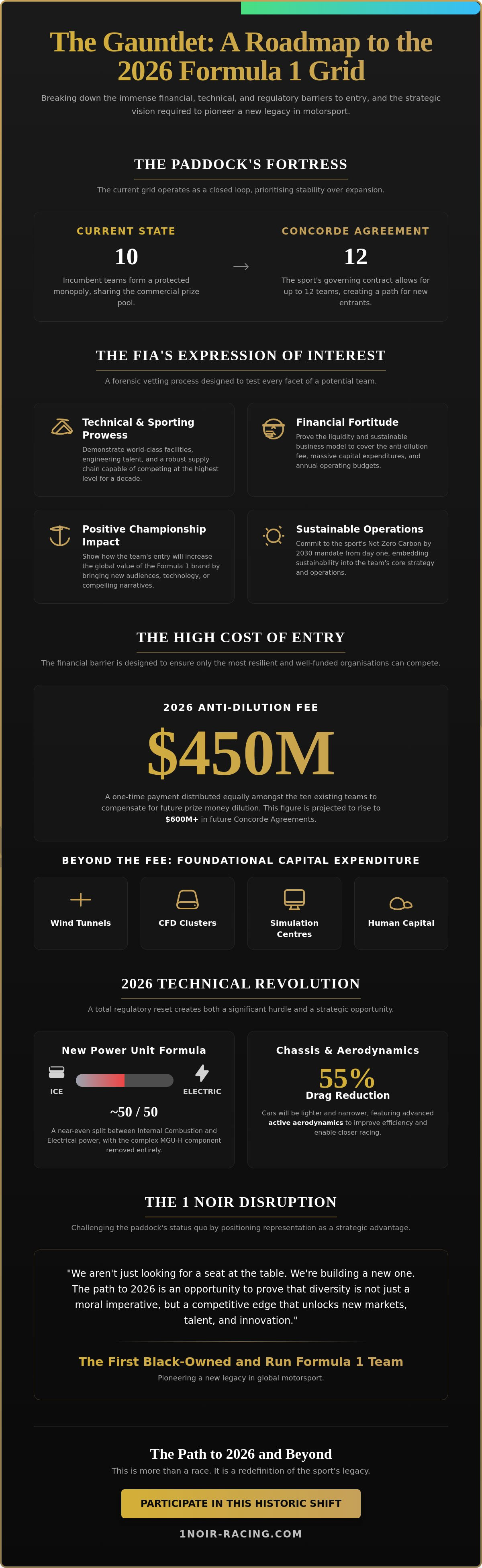
- The Concorde Agreement: This confidential tripartite agreement between the FIA, FOM, and the existing teams governs the sporting and commercial landscape of F1. It dictates the maximum number of teams on the grid (currently 12) and establishes the financial framework, including the formidable "Anti-Dilution" fee.
- A New Era of Expansion: For years, the grid was a stable 10-team monopoly. The recent interest from major players like Andretti-Cadillac signalled a potential shift. Whilst their initial bid was not successful for an immediate entry, it has set a precedent, forcing the paddock to confront the reality of expansion and setting the stage for the next wave of serious contenders planning for the post-2030 era.
The FIA Selection Criteria
The FIA's vetting process is intentionally severe. It acts as a filter to eliminate all but the most serious, well-funded, and technically competent organisations. A prospective new Formula 1 team entry must demonstrate excellence across several key pillars:
- Technical and Engineering Resources: Candidates must prove they have, or can acquire, the infrastructure to design, manufacture, and operate a competitive F1 car. This includes everything from a state-of-the-art factory and wind tunnel access to world-class simulation tools and, crucially, the elite engineering talent to run them.
- Long-Term Financial Sustainability: A team must present a robust, multi-year business plan that proves it can operate sustainably under the financial cost cap. This involves demonstrating secured funding that covers not only the initial CapEx and entry fee but also the annual operational budget, which can exceed £150 million.
- Positive Impact on the Championship: This is a more subjective but equally critical criterion. The FIA and FOM assess whether a new team will enhance the championship's reputation, bring in a new fanbase, attract prestigious partners, or add to the sport's global narrative. It is a question of value beyond the timing sheets.
Regulatory Hurdles for the Future
The 2026 technical regulations represent one of the most significant shifts in the sport's modern history. Any team targeting a post-2030 entry must not only meet these standards but anticipate the next evolutionary step. The challenge is not just to catch up but to innovate from day one.
- Power Unit and Powertrain Mastery: The 2026 regulations mandate a new generation of hybrid power units with a greater emphasis on electrical power and 100% sustainable fuels. A new entrant must either secure a partnership with an existing manufacturer or undertake the colossal task of developing its own power unit—a feat of engineering few can attempt.
- Sustainability and ESG Commitments: Formula 1 is committed to being Net Zero Carbon by 2030. New teams are expected to embed sustainability into their operations from inception, from logistics and manufacturing to their corporate footprint. This is no longer a "nice-to-have" but a core regulatory and commercial requirement.
- Aerodynamic and Chassis Evolution: The 2026 cars will be smaller, lighter, and feature active aerodynamics to improve efficiency and racing. A future entrant must build a team capable of mastering these new concepts whilst operating within the constraints of the cost cap and restricted aerodynamic testing regulations.
The High Cost of Entry: Financial and Regulatory Barriers
The ambition to join the F1 grid is met with a financial reality of staggering proportions. The barriers to entry are deliberately high, designed to ensure only the most financially robust entities can withstand the immense and sustained costs of competition. The total capital required to launch a credible team from scratch is estimated to be approaching $1 billion.
- The "Anti-Dilution" Fee: This is the single largest cheque a new team must write. Paid to the existing ten teams, it compensates them for the dilution of their share of the annual prize money pot. The last Concorde Agreement set this fee at $200 million, but with team valuations soaring, there is intense debate to raise it to $600 million or more in the next agreement.
- Capital Expenditure (CapEx): Before a single car turns a wheel, hundreds of millions must be invested in infrastructure. This includes constructing or retrofitting a factory to F1 standards, purchasing advanced machinery (like autoclaves and CNC machines), and investing in essential technology like CFD clusters and driver-in-loop simulators.
- Operational Costs (OpEx): While the FIA Financial Regulations cap on-track performance spending (around $135 million), the total annual budget is far higher. It must also cover costs outside the cap, such as driver salaries, marketing, and the capital investment in facilities.
- Building vs. Buying: The alternative to a new entry is acquiring an existing team. While this provides a turnkey solution with staff and facilities, the purchase price of even a back-of-the-grid team now runs into the high hundreds of millions, reflecting the franchise's scarcity value.
The Anti-Dilution Fund Explained
The anti-dilution fee is the paddock's primary financial gatekeeper. It was introduced to transform F1 from an open competition into a franchise model, protecting the investments of the existing teams. Its logic is straightforward but brutal.
- Protecting the Prize Pot: F1's commercial rights revenue is distributed amongst the teams based on performance. The introduction of an 11th team means the prize money is split 11 ways instead of 10, reducing the share for each incumbent. The fee is their compensation for this future loss of income.
- A Filter for Serious Bids: The sheer size of the fee—whether $200m or a future figure of $600m+—instantly filters out all but the most well-capitalised contenders. It is a clear signal to the FIA and FOM that a prospective entrant has the financial might to compete long-term.
- A Point of Contention: The exact value of the fee is a major point of negotiation for each new Concorde Agreement. Existing teams argue for a higher number to reflect their rising franchise values, whilst proponents of expansion argue that an excessively high fee makes a new Formula 1 team entry commercially unviable.
Infrastructure and Human Capital
Beyond the entry fee, the real challenge lies in building a living, breathing organisation capable of competing with legendary constructors like Ferrari, Mercedes, and McLaren. This requires more than just money; it requires a strategic investment in physical and human assets.
- The Technology Arms Race: A modern F1 factory is a temple of technology. Wind tunnels for aerodynamic testing, powerful CFD (Computational Fluid Dynamics) computer clusters for virtual simulation, and advanced manufacturing capabilities are the bare minimum. The cost of this infrastructure alone can exceed £150 million.
- The War for Talent: Formula 1's most valuable asset is its people. Attracting and retaining elite engineers, aerodynamicists, strategists, and mechanics is fiercely competitive. A new team must offer not only competitive salaries but also a compelling vision to lure top talent away from established teams.
- Global Logistical Operations: Competing in a 24-race global championship is a monumental logistical exercise. A new team must build a world-class race team and logistics department capable of transporting personnel and equipment across five continents with military precision. This is a complex, high-cost operation that runs year-round.
The Strategic Value of a New F1 Entrant
If the costs are so astronomical, why would anyone attempt a new Formula 1 team entry? Because a Formula 1 team is no longer just a racing enterprise; it has evolved into a unique and highly sought-after asset class. With a capped number of entries and a rapidly growing global audience, an F1 franchise offers unparalleled commercial and strategic value.
- A "Unicorn" Asset Class: With the cost cap controlling spending and revenues soaring, F1 teams have become profitable, high-growth businesses. Team valuations have skyrocketed, with some now exceeding $3 billion. An F1 entry is a scarce asset with a proven track record of significant appreciation.
- Unmatched Global Platform: Formula 1 boasts a cumulative annual television audience of over 1.5 billion people. For a global brand, car manufacturer, or sovereign wealth fund, a team provides a marketing and technology showcase with a reach that few other platforms can match.
- The Ultimate B2B Network: The F1 Paddock is one of the most powerful business networking environments on the planet. Team ownership grants access to a C-suite network of global CEOs, tech innovators, and influential figures, creating unique opportunities for partnership and collaboration.
- The "Drive to Survive" Effect: The Netflix series has supercharged F1's growth, particularly in the lucrative North American market. This has unlocked a new generation of fans and, crucially, a new wave of American corporate sponsors eager to engage with the sport.
Formula 1 as a Marketing Powerhouse
Team ownership or partnership offers a dynamic platform for brand building and corporate engagement that transcends simple sponsorship. It is about embedding a brand into the very fabric of a globally revered spectacle.
- Unrivalled Brand Visibility: A team's car, drivers, and personnel are broadcast to hundreds of millions of viewers in over 200 territories every other weekend. This provides a consistent and high-impact platform for global brand exposure.
- From Sponsorship to Strategic Partnership: The model has shifted from passive "sticker on a car" sponsorship to deep, technical partnerships. Brands are now leveraging F1 to co-develop technology, showcase innovation (e.g., in cloud computing, cybersecurity, or materials science), and tell powerful stories.
- Elite Corporate Hospitality: The F1 Paddock Club offers an unparalleled money-can't-buy experience for high-value clients and stakeholders. A team can host its most important partners at the heart of the action, strengthening relationships in a high-octane environment. For those considering early stage motorsport investment, this B2B potential is a significant driver of long-term value.
Venture Capital in Motorsport
The financial stability and growth trajectory of F1 have attracted a new breed of owner: private equity and venture capital firms. They see F1 teams not as a passion project, but as a strategic investment with clear financial returns.
- The Influx of Private Equity: Firms like RedBird Capital (Alpine), MSP Sports Capital (McLaren), and Ineos (Mercedes) have invested billions into F1 teams. They are drawn by the predictable revenue streams, controlled costs, and massive growth potential of the sport's commercial rights.
- The Power of Scarcity: With only 10, 11, or at most 12 franchises available globally, an F1 team is a rarer asset than an NFL or Premier League team. This inherent scarcity protects valuations and ensures high demand should an owner wish to sell.
- Clear Exit Strategies: The investment thesis is clear: acquire a stake in a team, provide capital and expertise to improve its performance and commercial operations, and exit after a period of significant value appreciation. The rising tide of F1's popularity provides a strong tailwind for this strategy.
Challenging the Status Quo: Why Representation is the Next Frontier
For decades, the criteria for a new F1 entry were purely technical and financial. But a new, powerful metric is emerging: social and cultural impact. In a world demanding more from its institutions, a team's purpose is becoming as important as its performance. The next disruptive entry will not just be fast; it will be meaningful.
- A Systemic Lack of Diversity: Formula 1 has long faced criticism for its lack of diversity, particularly in positions of leadership, engineering, and ownership. The grid remains a largely homogenous environment, unreflective of its vast global audience.
- The Black-Owned Team as the Ultimate Disruptor: A team founded and run by Black leadership is not merely an incremental change. It is a fundamental disruption to the established order. It challenges unconscious bias and creates a new paradigm for what an F1 team looks and feels like.
- Unlocking Untapped Commercial Potential: A team that genuinely represents diverse communities can connect with a vast, passionate, and commercially powerful global fanbase that has historically been underserved by the sport. It opens doors to new markets and new corporate partners.
- Connecting ESG with High Performance: Social impact is no longer a separate corporate initiative; it is integral to a modern business's success. A purpose-driven team demonstrates that a commitment to Environmental, Social, and Governance (ESG) principles can coexist with an elite, high-performance culture.
The Power of Ownership vs. Participation
True change is not delivered through passive initiatives or marketing campaigns. It is driven by those who hold power. The distinction between participating in the system and owning a part of it is the difference between cosmetic change and structural transformation.
- Beyond "Diversity Stickers": While driver diversity programmes are important, they do not address the systemic issue. Real change comes from the top. Ownership dictates culture, strategy, and, ultimately, who gets a seat at the table.
- Ownership as a Catalyst for Talent: A Black-owned team creates a powerful new pathway for diverse engineering, marketing, and strategic talent. It provides a platform where meritocracy can thrive, free from the systemic barriers that have existed for generations.
- The Psychological Impact: The sight of a Black-run team competing on the global grid sends a powerful message to millions of aspiring engineers, drivers, and leaders worldwide. It makes the impossible seem possible and redefines the boundaries of ambition.
The ESG Business Case
In the modern investment landscape, purpose and profit are intrinsically linked. Partners and investors are increasingly directing capital towards ventures that deliver not only financial returns but also a measurable positive impact on society.
- The Demands of Modern Partners: Global brands are now held to a higher standard. They are actively seeking partnerships that align with their own ESG commitments. A purpose-driven F1 team offers a unique and high-profile platform to demonstrate these values in action.
- Creating a Legacy Beyond the Racetrack: Victories fade, but legacy endures. A team built on a foundation of inclusion and representation creates a legacy that transcends race results, building lasting brand equity and goodwill.
- A Black-owned Formula 1 team status creates a unique market advantage by unlocking untapped global fanbases and aligning with the non-negotiable ESG mandates of modern corporate partners, transforming social impact into a powerful commercial asset.
The Path Forward: Joining the 1 NOIR Journey
The next window for a new Formula 1 team entry may be post-2030, but the work begins now. Building a championship-calibre organisation is a marathon, not a sprint. It requires years of meticulous planning, strategic capital investment, and the assembly of a world-class team. 1 NOIR Racing is on this journey, laying the foundations today for the grid of tomorrow.
- A Roadmap to the Grid: 1 NOIR Racing is executing a long-term strategy to build the first Black-owned and run Formula 1 team. The roadmap involves securing foundational partners, developing technical infrastructure, and assembling the core leadership team needed to launch a credible bid when the next EOI process opens.
- An Invitation to Visionary Partners: This is an opportunity to get in on the ground floor of a historic venture. We are inviting visionary investors and corporate partners who understand the unique intersection of high-performance sport, disruptive technology, and systemic social change.
- The Urgency of the Moment: The landscape of Formula 1 is shifting. The time to build the team of the future is now, to be perfectly positioned for the next regulatory and commercial era.
- A Centre for Excellence and Inclusion: 1 NOIR is being built not just to compete, but to win. And to win by creating a culture of uncompromising excellence that draws on the best talent from all backgrounds.
A Manifesto for the Future
The 1 NOIR Racing mission is built on three core principles. It is a new formula for success, a new definition of what a racing team can be.
- Uncompromising Excellence: Our commitment is to high performance in every facet of the organisation, from the factory floor to the boardroom. We will not compromise.
- A Team that Reflects the World: We are building an organisation that mirrors the global, diverse audience of Formula 1. True strength comes from a multitude of perspectives.
- Prestige with a Purpose: We believe in the power of Formula 1 to be a force for good. Our purpose is to achieve competitive success whilst driving meaningful, structural change.
How to Get Involved
This is more than an investment. It is a chance to co-author a new chapter in motorsport history. We are seeking partners who share our ambition and our values.
- Strategic Capital Investment: Opportunities are available for cornerstone investors who want to be part of the foundational capital structure of the team.
- Corporate Partnership Models: We are developing bespoke partnership opportunities for global brands who want to align with a story of innovation, performance, and purpose.
- CTA: Join the mission to build the first Black-owned F1 team.